
When people imagine a “Great Wall” of concrete, thoughts often turn to China’s ancient fortification or the vast infrastructures of the U.S. Instead, one of the most ambitious defensive walls in the modern world lies elsewhere stretching along the Pacific shores of Japan, built not to fend off armies, but to protect lives from the fury of the sea.
A Nation Shaped by the Ocean’s Wrath
Japan’s geography places it at the mercy of seismic forces. The archipelago sits along the Pacific Ring of Fire, a zone of intense earthquake and volcanic activity. This vulnerability was tragically underscored on March 11, 2011, when a massive earthquake triggered a tsunami, whose towering waves devastated coastal communities and caused the Fukushima nuclear disaster. Nearly 20,000 lives were lost, and the catastrophe exposed the limits of Japan’s existing coastal defenses.
 WhatsApp Image 2024 07 01 at 13.58.28 4cfca4e0
In response, the government launched an extraordinary engineering project a network of massive concrete seawalls designed to act as a bulwark against future tsunamis.
Engineering Japan’s ‘Great Wall’
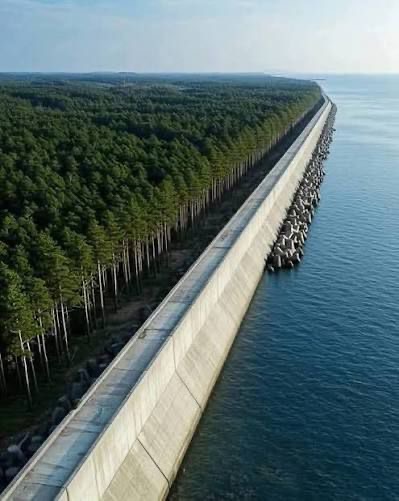
Stretching roughly 250–400 miles (400 km) along vulnerable coastlines, Japan’s tsunami wall system has been likened to a “Great Wall” of concrete due to its sheer scale and ambition. In key areas, the barriers rise to nearly 46 feet high, equivalent to a four- or five-story building with deep foundations anchored up to 82 feet underground to resist immense wave forces.
These colossal structures are engineered to blunt and slow incoming tsunami waves, reduce the force of water surges, and crucially buy extra time for evacuation. While no wall could entirely stop the most extreme tsunamis, officials argue that even minutes of delay can make the difference between life and death for coastal residents.
Beyond Concrete: A Hybrid Defense Strategy
Japan’s approach to tsunami defense is not limited to gray concrete. The seawalls are part of a more comprehensive coastal resilience strategy that includes:
- Advanced early warning systems and sirens.
- Clearly marked evacuation routes and disaster drills.
- Natural defenses, such as the planting of millions of trees along the coast to absorb wave energy and catch debris.
This blended strategy aims to combine the strengths of human engineering with ecological solutions to create a layered defense against a force of nature that cannot be fully controlled.
Controversy and Community Impact
Despite its life-saving purpose, Japan’s concrete “Great Wall” has sparked controversy. Critics including environmentalists, local citizens, and tourism stakeholders argue that the imposing barriers scar the coastline, disrupt marine ecosystems, and obstruct scenic ocean views that are central to local culture and commerce. Some communities have even resisted sections of seawall construction for these reasons.
Still, in a nation where earthquakes and tsunamis are a recurring threat, government leaders maintain that such infrastructure combined with preparedness and early response systems remains essential for protecting coastal populations.
A Legacy of Resilience
Japan’s concrete seawalls stand as both a physical and symbolic response to one of the deadliest natural disasters of the 21st century. While debate continues over their effectiveness and environmental impact, these massive coastal defenses reflect a national commitment to resilience, one deeply shaped by the lessons of past tragedy.
Originally written by:Claudia Sànchez and Roddy Cons
Link to the article: https://en.as.com/latest_news/not-china-or-the-us-this-country-built-a-massive-great-wall-of-concrete-to-defend-against-tsunamis-n/