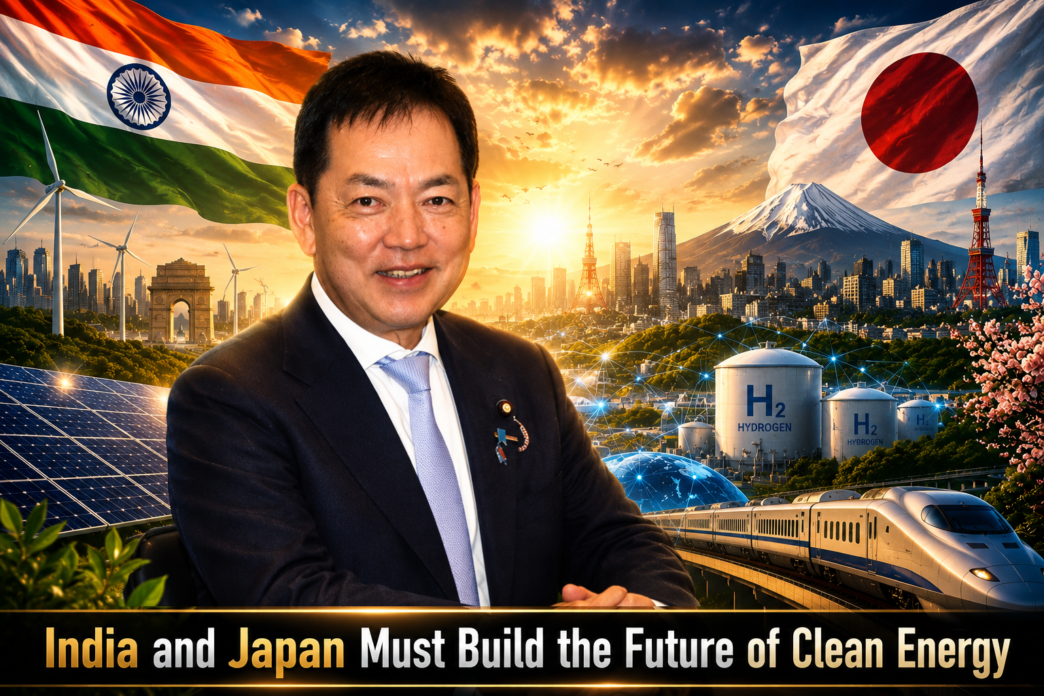
Tokyo, Japan: Speaking at the Rising India 2 India-Japan Business Conclave held on June 17, 2026 at the Akasaka Prince Classic House in Tokyo, H.E. Mr. Keiichiro Asao, Former Minister of the Environment and sitting Member of the House of Councillors of Japan, delivered an address that moved from personal memory to bold policy vision making a compelling case for why India and Japan must become clean energy partners for the decades ahead.
Mr. Asao opened with a personal story. His only visit to India was in 1985, as a high school student who had won Japan’s Prime Minister’s Award for an essay on economic cooperation. The reward was a commendation trip to India and Southeast Asia, during which he visited Calcutta then home to Mother Teresa and Delhi. “That India and today’s India are completely different,” he told the audience, adding that he had turned to Mr. Toshihiro Suzuki, President of Suzuki Motor Corporation, who was seated in the room, to ask whether the old Ambassador car still existed in India. It does not and Mr. Asao said that small fact said everything.
 WhatsApp Image 2024 07 01 at 13.58.28 4cfca4e0
The Stanford Story
In a moment that drew laughter and attention from Indian and Japanese attendees alike, Mr. Asao recalled his time at Stanford University’s Business School in the early 1990s. Of sixteen Japanese students in his cohort, only one ranked in the top ten percent and received the prestigious Arjay Miller Scholarship. Of twelve Indian students every single one did.
“The difference was not mathematics,” he said. “Japanese students are strong in mathematics, and so are Indian students. The difference was that at business school, you have to speak up and Japanese students tend to be less comfortable doing that.”
Japan’s Environment Lessons for India
Turning to policy, Mr. Asao drew on Japan’s own industrial history to make a case for collaboration. Japan once paid a heavy price for rapid economic growth with inadequate environmental regulation pollution followed, and stricter rules eventually had to be put in place. He urged India to draw on Japan’s experience to pursue growth without repeating those mistakes, particularly in water quality and air pollution.
He highlighted the Joint Crediting Mechanism (JCM), a programme agreed between Japan and India during Prime Minister Modi’s visit to Japan last year, under which carbon emission reductions achieved using Japanese-funded technology are shared as carbon credits between the two countries enabling more generous financial support than conventional trade-based channels allow.
Mr. Asao also pointed to Japan’s urban rail systems where trains run precisely on published timetables to the minute, in cities from Tokyo to Osaka as an underexported asset that could help India manage the traffic congestion and emissions pressures that rapid urbanisation will bring.
A Roadmap for Solar Fuel by 2040
Mr. Asao closed with the initiative he is most proud of from his tenure as Environment Minister: an ambitious national roadmap for artificial photosynthesis. The goal is to replicate what plants do naturally using sunlight to convert carbon dioxide and water vapor into fuel and to bring that artificially produced fuel to market at a cost lower than bioethanol by 2040.
“With a few breakthroughs in technologies Japan already has, we can convert CO2 from the air into carbon monoxide using only sunlight, extract hydrogen from water vapor, and combine them to produce ethanol,” he explained. He expressed hope that Japan and India would pursue this frontier together and that gatherings like Rising India 2 would serve as a step toward the joint programmes that could make it possible.
Rising India 2 was organised by Connect India Japan, a platform dedicated to strengthening bilateral relations between India and Japan. The conclave was held on June 17, 2026 at the Akasaka Prince Classic House, Tokyo.