
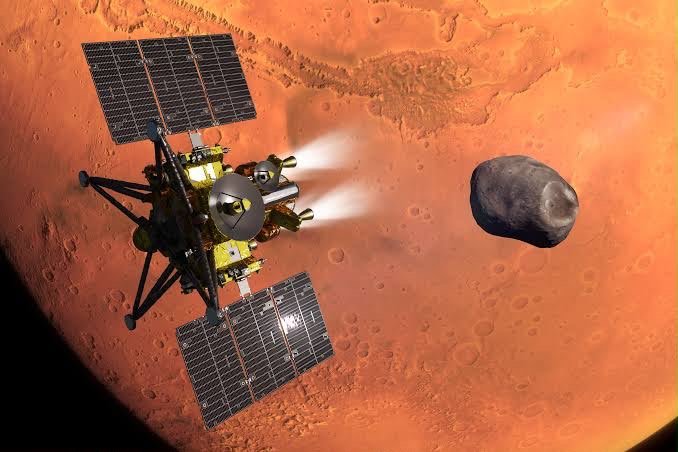
Japan is preparing for a major milestone in space exploration with its Martian Moons eXploration (MMX) mission, designed to collect samples from Phobos, one of Mars’ two moons, and bring them back to Earth. Led by the Japan Aerospace Exploration Agency (JAXA), the mission is scheduled to launch on October 20, 2026, aboard an H3 rocket from Tanegashima Space Center.
The ambitious mission aims to help scientists understand how Mars’ moons formed, how material moves through the Solar System and whether these bodies preserve clues about the conditions needed for life.
 WhatsApp Image 2024 07 01 at 13.58.28 4cfca4e0
A World-First Mission to Bring Back Phobos Samples
Phobos is the larger of Mars’ two moons, while Deimos is the smaller. Both remain poorly understood, and scientists continue to debate whether they are captured asteroids or formed from debris following a major impact on Mars.
The MMX spacecraft aims to collect at least 10 grams of surface material from Phobos and return it to Earth for detailed laboratory analysis. The mission is expected to take around five years, with the sample-return capsule targeted to reach Earth in 2031.
What the Mission Will Investigate
By studying Phobos’ surface and analysing its samples, researchers hope to find evidence that helps distinguish between competing theories about the moon’s origin.
The samples could contain material from Phobos itself, and possibly dust or fragments originating from Mars. Examining their composition may help scientists understand the evolution of the Martian system and the movement of water-bearing and organic materials through the early Solar System.
Although the mission may improve understanding of the conditions associated with habitability, it is not a direct search for living organisms. Its findings could instead provide important clues about the broader history of Mars and the ingredients associated with life.
A Complex Journey to Mars’ Moons
After launch, MMX is expected to reach the Martian system in 2027 and begin detailed observations of Phobos. The spacecraft will study the moon’s shape, surface, composition and gravity before attempting sample collection.
A European-developed rover named Idefix will also help investigate the moon’s surface. The mission plans to attempt two soft landings to gather samples from different locations, while observations of Deimos will be conducted during the later stages of the mission.
The collected material will be sealed inside a return capsule designed to separate from the spacecraft and travel back to Earth. Recovery is planned in Australia in 2031.
International Collaboration Supports the Mission
While JAXA leads MMX, the mission involves international partners, including NASA, the European Space Agency (ESA), the French space agency CNES and the German Aerospace Center (DLR).
NASA is contributing technical and communications support, while international cooperation is helping provide scientific instruments and other mission capabilities.
The collaboration builds on years of international work in planetary science and supports the development of technologies for future missions to Mars and its moons.
Preparing for Future Space Exploration
Beyond its scientific goals, MMX will test technologies for navigating the Martian environment, operating near a small moon and collecting material from a low-gravity surface.
These capabilities could be useful for future robotic exploration and long-term plans for human missions to Mars. Studying Phobos and Deimos may also help scientists assess whether Mars’ moons could serve as locations for future exploration activities.
Japan’s MMX mission represents a major step in exploring the Martian system. By collecting samples from Phobos and returning them to Earth, the mission aims to answer longstanding questions about the origins of Mars’ moons and the evolution of the Solar System.
With launch scheduled for October 20, 2026, and sample return targeted for 2031, the mission could provide scientists with material that can be studied using instruments far more advanced than those carried aboard a spacecraft. Its results may reshape understanding of Mars’ neighbourhood and help prepare for future journeys deeper into space.