Introduction
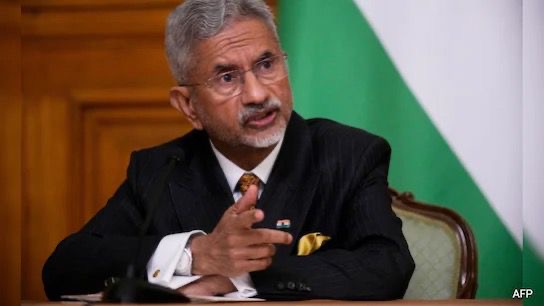
At the recently held 8th India‑Japan Indo‑Pacific Forum, External Affairs Minister S. Jaishankar underlined the deepening partnership between India and Japan, emphasising how it “enhances strategic stability in the Indo-Pacific” and contributes to global economic growth.


Below is a detailed article exploring the significance of this statement, examining why the India-Japan partnership matters for the Indo-Pacific region, what are the concrete mechanisms involved, and what challenges lie ahead.
Why the India-Japan partnership is strategically important
Shared identity as democracies & maritime nations
● India and Japan are both major democracies and maritime powers. Jaishankar stated that “as two major democracies and maritime nations, India and Japan have a larger responsibility towards the Indo-Pacific.”
● The maritime dimension is important: the Indo-Pacific region is rich in strategic sea-lanes, connectivity corridors, and faces challenges like maritime security, resource competition, and power projection.
A “free and open Indo-Pacific” as a guiding concept
● Jaishankar emphasised that “maintaining a free and open Indo-Pacific is a stronger imperative but also a more complex challenge.”
● The “free and open” formulation implies rule-based order, transparency, maritime navigation rights, and inclusive development rather than coercion.
Strategic stability and economic resilience
● The partnership is not just about defence/security but also economic and technological cooperation. Jaishankar noted it “serves to enhance strategic stability in the Indo-Pacific and contribute to the economic one at a global level.”
● In a world of shifting supply-chains, technology competition and critical minerals, the India-Japan axis is positioned to contribute to resilience.
What are the key areas of cooperation?
Jaishankar outlined several concrete initiatives and domains that highlight the evolving India-Japan relationship.
● The partnership now includes frameworks such as the Next Generation Mobility Partnership, the Economic Security Initiative, the Joint Declaration on Clean Hydrogen and Ammonia, and a MoU in the field of mineral resources.
● The Indo‑Pacific Oceans’ Initiative where Japan co-leads the Maritime Trade, Transport and Connectivity pillar is highlighted as having potential to advance contributions.
Focus areas for the next decade
● Jaishankar specifically mentioned that India and Japan must focus on leveraging their strengths in: artificial intelligence, semiconductors, critical minerals, clean energy, and space.
● A target of 10 trillion yen of investment over the next decade between the two countries was flagged (this aligns with the new Vision Plan announced earlier).
● Beyond government-to-government ties, Jaishankar emphasised the importance of “people-to-people exchanges” via the “Action Plan for Human Resource Cooperation and Exchange.” These are expected to deepen societal understanding of each other.
Implications for the Indo-Pacific region
The India-Japan partnership adds a stabilising axis in a region characterised by increasing uncertainty. A few implications:
● By collaborating, India and Japan send a signal of shared commitment to a rules-based maritime order, which can reassure smaller states and maritime users.
● Their role as maritime democracies enhances capacity for joint deterrence, maritime domain awareness, and cooperative security measures.
● Economic cooperation (for example in supply chains, clean energy) enhances resilience of states in the region against disruptions, and builds infrastructure alternatives.
Economic opportunity and diversification
● Japanese investments in India can complement Indian large-scale market and human capital, crafting manufacturing and innovation hubs that serve the region.
● Via joint efforts in clean hydrogen, mobility, minerals, the partnership offers new value chains that are less dependent on single-source risk (for example China).
● Improved connectivity (physical, digital) under the Indo-Pacific rubric can expand trade, technology flows, and investment across the region.
● With the backdrop of renewed great-power competition (particularly China’s maritime assertiveness and US-China rivalry), the India-Japan partnership signals a proactive stance by two large Asian democracies.
● This does not necessarily mean confrontation, but it emphasises strategic agency, alignment on key global issues, and shared responsibility for regional stability.
While the partnership has many strengths, there are also realistic constraints to keep in mind.
Diverse threat perceptions & strategic culture
● India has traditionally followed a non-aligned or multi-aligned posture rather than formal alliances; Japan has a security treaty with the US and its strategic culture differs. Reconciling these may require calibration. (See earlier statements by Jaishankar on Asian NATO discourse).
● The notion of an Indo-Pacific axis could be viewed differently by various states. India must balance its independent diplomacy with partnership commitments.
Implementation and follow-through
● Announcing 10 trillion yen investment is ambitious, but execution requires regulatory alignment, infrastructure readiness, and risk mitigation.
● In sectors such as semiconductors, clean hydrogen, critical minerals, the competition is intense and technology cycles are fast. Sustained collaboration is vital.
● People-to-people exchanges, educational linkages, cultural affinity – these are long-term programmes and take time to manifest into strategic benefit.
● China remains a key neighbour for both India and Japan; the bilateral cooperation will need to manage careful messaging to avoid undue escalation or misinterpretation.
● Further, the region also includes smaller states with their own sensitivities. Any major cooperation should be inclusive, not perceived as exclusionary.
● Supply-chain resilience and critical-minerals security are also subject to global market fluctuations, geopolitics, and environmental considerations.
What this means for India & Japan and for India-Japan relations specifically
● India gains a partner with advanced technological capabilities, high-quality infrastructure experience (e.g., Japanese involvement in high-speed rail, urban transport) and access to Japanese capital.
● In the wider Indo-Pacific strategy, India strengthens its maritime and economic outreach, aligning with its “Act East” and broader regional ambitions.
● The focus on semiconductors, critical minerals, clean energy aligns with India’s national ambition of building manufacturing capacity and exporting talent/technology.
● Japan gets a strategically located partner in India with one of the world’s fastest-growing large economies, demographic advantages, and a democratic system aligned with Japanese values.
● Through India, Japan can diversify its investments, reduce dependence on risk-prone supply chains, and enhance its role in the Indo-Pacific.
● Engagement in India supports Japan’s vision of a Free and Open Indo-Pacific (FOIP) and gives Tokyo a credible vehicle for regional connectivity and resilience.
● The partnership has moved from predominantly bilateral trade and infrastructure towards a multi-dimensional “special strategic and global partnership” security, technology, human capital, and global governance.
● The joint vision (via the eight pillars and investment target) provides a roadmap for the next decade. Jaishankar’s speech underlines that the relationship has “greater value than ever before.”
● Given this momentum, the household names of the future bilateral agenda may include next-gen mobility, hydrogen/ammonia economy, space collaboration, AI, and resilient supply-chains.
The remarks by S. Jaishankar at the India-Japan Indo-Pacific Forum offer a clear, strategic statement: the India-Japan partnership is no longer just a bilateral cooperation, it is a regional stabiliser and economic growth engine for the Indo-Pacific.
By combining democratic credentials, maritime reach, technological ambition and investment scale, India and Japan are positioning themselves to shape a future where the Indo-Pacific remains free, open, inclusive, and resilient rather than exclusive, fractured or dependent.
For policymakers, business leaders, civil society and regional stakeholders, the message is: this is a partnership worth watching one that offers opportunities (investments, trade, technology) and also responsibilities (maritime security, rule-based order, connectivity). The next decade will be decisive in how well India and Japan turn announced ambition into operational reality.
Originally source of the news: https://www.ndtv.com/india-news/india-japan-partnership-enhances-stability-in-indo-pacific-s-jaishankar-9581830