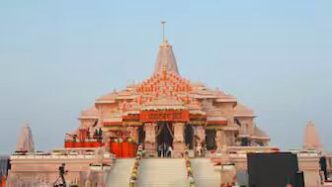
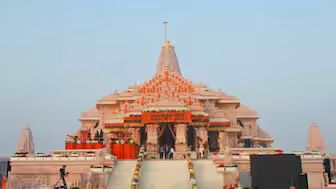
The Ram Mandir flag-hoisting ceremony formally called Dhwajarohan is a ceremonial event held at the top of the Ram Mandir’s spire, marking the “formal completion” of the temple’s construction. On 25 November 2025, the ceremony attained historic significance as the sacred flag was officially hoisted atop the temple, in presence of high dignitaries.
The flag being hoisted is the Dharma Dhwaj a right-angled, triangular saffron flag bearing sacred symbols such as a radiant Sun (signifying Lord Ram’s lineage), the sacred syllable “Om” and a depiction of the “Kovidara tree.” These symbols are intended to evoke spiritual continuity, cultural heritage and the ideals of “Ram Rajya.”


The event coincided with the auspicious date of Vivah Panchami the traditional date believed to mark the divine wedding of Lord Ram and Devi Sita. Moreover, the timing of the flag-hoisting was during the auspicious “Abhijit Muhurat,” underscoring the spiritual and cultural importance of the moment.
Why is this ceremony significant?
- Marks Completion of the Temple: The Dhwajarohan effectively formalizes that the Ram Mandir is structurally complete following earlier milestones such as the consecration of the idol (Pran Pratishtha) in 2024.
- Symbolic Representation of Faith and Identity: The flag and ceremony act as an affirmation of faith for millions of devotees, symbolizing the restoration of what many regard as a sacred birthplace and heritage site. The flag’s symbols Sun, Om, Kovidara tree link heritage, spirituality, and the ideals associated with Ram.
- Cultural-Spiritual Milestone: Given the long contentious history around the site, the ceremony represents a closure of a chapter (construction) and the beginning of a new one where the temple stands as a place of worship, cultural unity and spiritual renewal. Many news reports frame the event as “healing centuries-old wounds.”
What happened on 25 November 2025 The Ceremony Day
- The ceremony was performed by Narendra Modi (Prime Minister of India) along with RSS chief Mohan Bhagwat, in presence of dignitaries including the Governor of Uttar Pradesh and the Chief Minister.
- Before the flag-hoisting, the Prime Minister visited various temple precincts including the Saptmandir complex, the Mata Annapurna Mandir, and offered prayers at the main sanctum (Garbh Grah) of the temple.
- The saffron “Dharma Dhwaj” was hoisted at about 11:50–11:55 AM (during the Abhijit Muhurat), triggering widespread celebrations.
- Thousands of invitees including tribal leaders, people associated with the temple movement, devotees as well as dignitaries were present. The surrounding city of Ayodhya was decorated, security heightened, and the atmosphere was described as festive and deeply spiritual.
Symbolism and Cultural Meaning of the Flag
The “Dharma Dhwaj” hoisted at the top of the temple is not a mere standard flag it carries layers of cultural, spiritual, and civilizational meaning:
- Sun: Represents the lineage of Lord Ram (Suryavansh), valor, radiance, and the eternal cycle of dharma (righteousness).
- Om: The primal cosmic sound; signifies spiritual energy, unity with the divine, and the eternal essence of the universe.
- Kovidara Tree: According to tradition, a sacred tree associated with harmony, ancient wisdom and ecological heritage. It connects the temple to a broader mythological and civilizational past.
By placing this flag atop the temple visible from afar the ceremony sends a message of continuity: that the spiritual legacy endures, and that the temple now stands ready as a living centre for devotion, culture and identity.
Why the Ceremony Matters for India (Beyond Ayodhya)
- National Identity & Cultural Heritage: For many across India, the completion of the Ram Mandir and this flag-hoisting marks a reclaiming of a shared cultural and religious heritage an event of national significance, not only local or regional.
- Symbol of Reconciliation & Closure: Given the decades-long dispute and eventual resolution related to the site, the flag-hoisting brings closure. As some media described it: “centuries-old wounds healing.”
- Renewed Spiritual & Cultural Focus: The temple with its architecture, scriptures, and symbolism now stands as a centre for cultural memory, pilgrimage, and spiritual continuity. The ceremony reinforces that narrative.
- Unity and Message of Dharma: The ritual underlines themes of unity, respect for tradition, and reaffirmation of values associated with dharma and harmony especially through symbols like the Dharma Dhwaj.
What It Means Going Forward
- The completion of the temple with this ceremony opens a new era for pilgrimage, worship and visits to the temple complex. The temple will now function as a fully operational spiritual centre.
- The flag being a visible emblem may become a point of identity and rallying symbol for devotees across India and abroad.
- The event may also spur increased religious tourism, infrastructural development in Ayodhya, and a renewed cultural-heritage narrative centered around the temple.
On a broader level, it redefines how many view the temple not just as a religious site, but as a symbol of heritage, unity and national pride.
Originally written by: https://www.firstpost.com/explainers/ayodhya-ram-temple-flag-hoisting-ceremony-pm-modi-13953754.html