

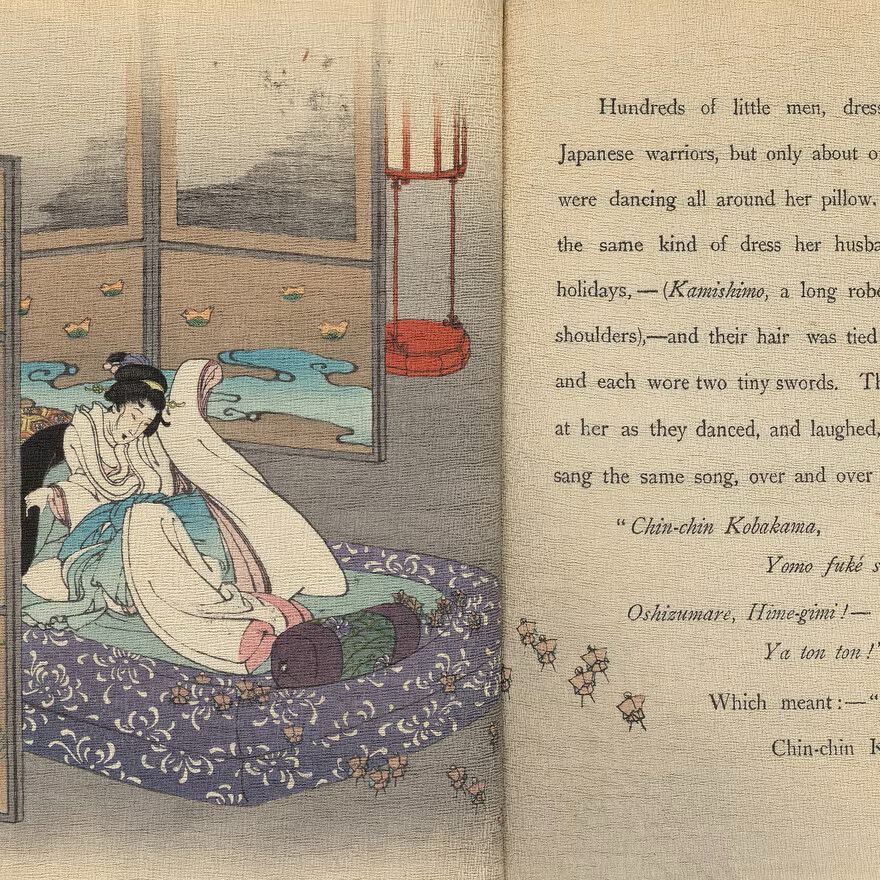
In the late 19th and early 20th centuries, a curious kind of book began to circulate in Europe and America soft to the touch, vibrant in color, and unlike anything found in Western libraries. These were the famous Japanese crêpe-paper books, or chirimen-bon, delicately printed works that carried the textures, tales, and traditions of Japan into the hands of foreign readers.
They were more than just books; they were tactile ambassadors of culture each page rustling softly like the silk robes of the characters within.
 WhatsApp Image 2024 07 01 at 13.58.28 4cfca4e0
The Birth of the Crêpe-Paper Book
The story of these books begins in Meiji-era Japan (1868–1912), a time when the country was rapidly modernizing and opening itself to global influence after centuries of isolation. As Western visitors arrived, so too did a hunger for “exotic” glimpses into Japan its legends, art, and way of life.
Enter Takejiro Hasegawa, a visionary Tokyo-based publisher. Hasegawa saw an opportunity to share Japanese stories with the West in a format that would be both durable and aesthetically captivating. Around 1885, he began producing English-language books printed on chirimen paper a type of crêped paper that had a unique texture, making the books resistant to tearing and humidity. This innovation transformed traditional Japanese printing into a global export.
Hasegawa’s books were small but exquisite. They featured Japanese woodblock prints illustrating tales from folklore, fairy stories, and cultural life, paired with English translations often crafted by foreign missionaries or scholars living in Japan.
Popular titles included:
● Momotaro: The Story of a Japanese Boy
● The Matsuyama Mirror
● The Tongue-Cut Sparrow
● The Ogres of Oyeyama
Each story carried a moral core drawn from Japanese tradition loyalty, humility, courage yet spoke in a language and format familiar to Western readers. This balance of authentic content and accessible storytelling made the books ideal souvenirs for travelers and collectors.
What truly set these books apart was their texture. The crêped paper was achieved by mechanically compressing the printed sheets, giving them a soft, fabric-like feel. Each page rippled like waves echoing Japan’s natural landscapes and the graceful flow of traditional brush art.
This tactile quality fascinated Western readers. In an age of industrial printing and uniformity, the hand-crafted feel of Hasegawa’s books embodied the charm of the handmade an aesthetic Japan would later popularize worldwide through movements like wabi-sabi and mingei.
Through these crêpe-paper books, Japanese art and values reached audiences far beyond Asia. They offered a gentle introduction to Japan not through grand diplomacy or trade, but through intimate storytelling and texture. The books also reflected Japan’s early efforts in cultural diplomacy, using literature and design to shape how the world perceived it.
Hasegawa didn’t stop at English editions. His works were later translated into French, German, Spanish, and Portuguese, expanding Japan’s literary footprint even further. Each edition carried the same care in illustration and production, reinforcing the universality of storytelling.
From Souvenirs to Collectors’ Treasures
Today, these crêpe-paper books are prized by collectors, museums, and bibliophiles around the world. Institutions such as the Smithsonian Libraries, Harvard University, and the British Museum house extensive collections of Hasegawa’s works, preserving their delicate pages for future generations.
Their significance goes beyond their beauty they represent a moment in history when print became a bridge between East and West, between tradition and modernity. They also remind us that sometimes, a nation’s culture travels best not through power, but through paper.
More than a century later, the charm of Hasegawa’s crêpe-paper books endures. Their textured pages whisper of an age when every story was crafted by hand, when art and language worked together to cross oceans. In an era of digital screens and instant translations, their presence feels almost miraculous a reminder that true cultural exchange can be both delicate and enduring.
Just as their pages never tear, the connection they created between Japan and the world remains unbroken soft, strong, and timeless.
Originally written by: Mike Cummings
Link to the article : https://news.yale.edu/2025/11/06/textured-stories-crepe-paper-books-brought-japanese-culture-western-readers
Detail from “Chin Chin Kobakama” (The Toothpick Samurai).
(Image courtesy of Yale Library)