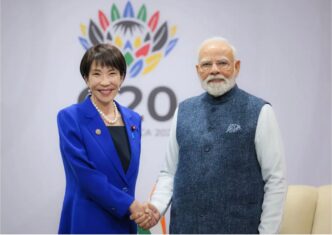
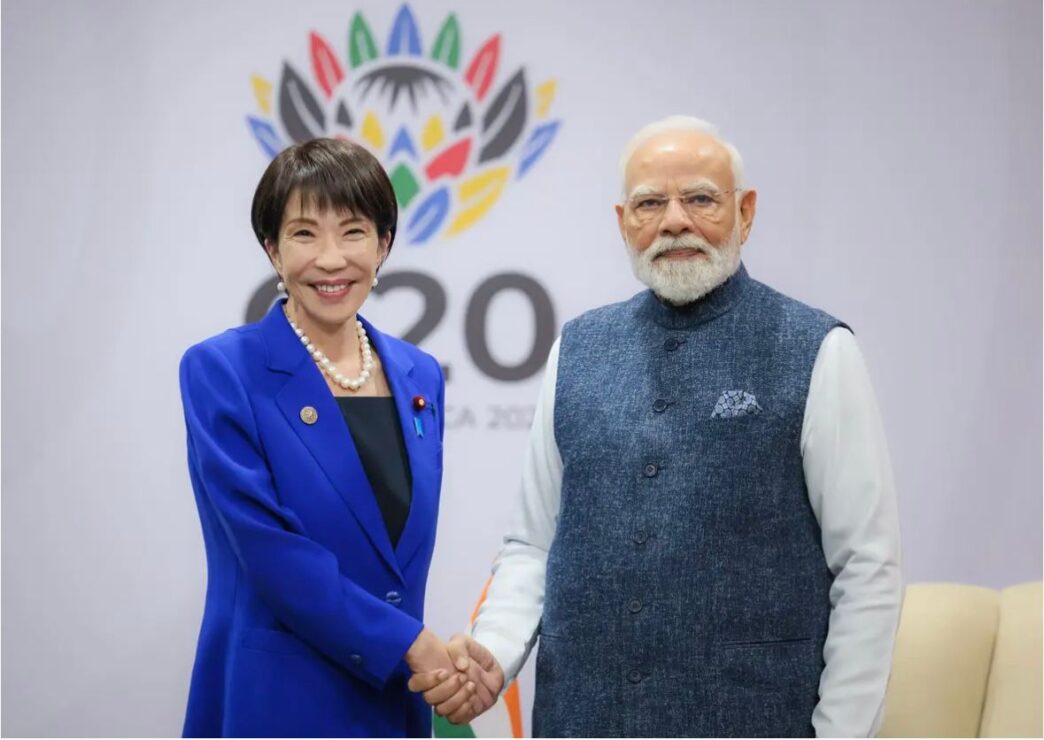
In a highly productive meeting with Japanese Prime Minister Sanae Takaichi, Indian Prime Minister Narendra Modi underscored a shared determination to deepen bilateral cooperation across a broad spectrum from innovation and defence to talent mobility and trade. Their discussions reflect a renewed ambition to give fresh momentum to the Indo-Japan special strategic partnership and lay the groundwork for a stronger, more resilient future.
Building on a Decade-Long Vision
Central to their engagement is the recently adopted India–Japan Joint Vision for the Next Decade, a forward-looking roadmap that charts eight pillars of cooperation. These pillars include:
 WhatsApp Image 2024 07 01 at 13.58.28 4cfca4e0
- Next Generation Economic Partnership,
- Economic Security,
- Mobility,
- Ecological Legacy,
- Technology & Innovation,
- Health,
- People-to-People Exchanges,
- State-Prefecture Engagement.
Both leaders reaffirmed their commitment to realizing this vision a blueprint that goes well beyond conventional diplomacy to involve government, business, civil society, and subnational actors.
Innovation and Trade: Tapping into Complementarity
At the heart of the discussion was the idea that Japanese technology and Indian talent are a “winning combination.” Under the economic dimension of the joint vision:
- Japan has set a target of ¥10 trillion (roughly $68 billion) in private investment in India over the next decade.
- Strategic collaboration will intensify in key sectors semiconductors, critical minerals, clean energy, telecommunications, and biotechnology to build resilient and diversified supply chains.
- There’s a renewed push to expand and deepen the Comprehensive Economic Partnership (CEPA) between the two countries.
This alignment of capital, technology, and human resources has the potential to turbocharge innovation, strengthen industrial capacity, and foster sustainable economic growth.
Defence & Security: A Strategic Reset
Both leaders placed defence cooperation at the forefront of their agenda. They committed to a Joint Declaration on Security Cooperation that elevates their partnership amid evolving geopolitical dynamics.
Key security priorities include:
- Enhancing maritime security and increasing the frequency and sophistication of joint military exercises.
- Strengthening defence-industrial collaboration, likely in sectors where technology and innovation intersect, such as aerospace, naval systems, and dual-use applications.
- Institutionalizing a dialogue at the National Security Adviser level, which will further align their strategic approaches.
This deeper security cooperation not only underlines shared concerns terrorism and cybersecurity were explicitly mentioned but also reaffirms their joint commitment to a free, open, peaceful, and rules-based Indo-Pacific.
Mobility and Talent: Bridging People Across Borders
Recognizing that people are the foundation of any enduring partnership, the two sides announced an ambitious Human Resource Exchange Action Plan:
- Over the next five years, they aim to facilitate the movement of more than 500,000 personnel between India and Japan.
- Among these, 50,000 skilled professionals from India will go to Japan, contributing their expertise to the Japanese economy and innovation ecosystem.
- There will also be stronger sub-national ties more city- and prefecture-level cooperation, sister-state arrangements, and increased regional business and cultural exchanges.
By fostering talent mobility, both countries are not just investing in immediate economic gains but building a lasting bridge of mutual understanding and shared human capital.
Innovation, Ecology & Health: A Shared Frontier
Beyond defence and trade, PM Modi and PM Takaichi pledged to expand cooperation in several high-impact and future-facing domains:
- Technology & Innovation: Joint R&D hubs in AI, robotics, cybersecurity, and space are set to proliferate.
- Ecological Legacy: They committed to clean-energy projects, ecological innovation, and sustainable infrastructure that address climate change challenges.
- Health: From pharmaceutical resilience to digital health, both nations aim to collaborate on holistic wellness, including traditional medicine (like Ayurveda) and cutting-edge biomedical research.
This multi-dimensional partnership is built not only on economic logic but on a shared vision of a sustainable, equitable future.
Why It Matters: A Strategic Partnership for Our Times
This renewed India–Japan push comes at a time when the global order is being redefined. With rising geopolitical tensions in the Indo-Pacific, supply chain vulnerabilities, and the accelerating pace of technological change, both nations see their partnership as a cornerstone of a stable, prosperous, and rules-based regional order.
Prime Minister Modi’s words capture it well: “A strong India-Japan partnership is vital for a better planet.” Their shared values democracy, rule of law, innovation and their complementary strengths lay the foundation for a decade marked by transformative cooperation.
News link: https://www.facebook.com/share/p/1AgGUHvpvc/?mibextid=wwXIfr