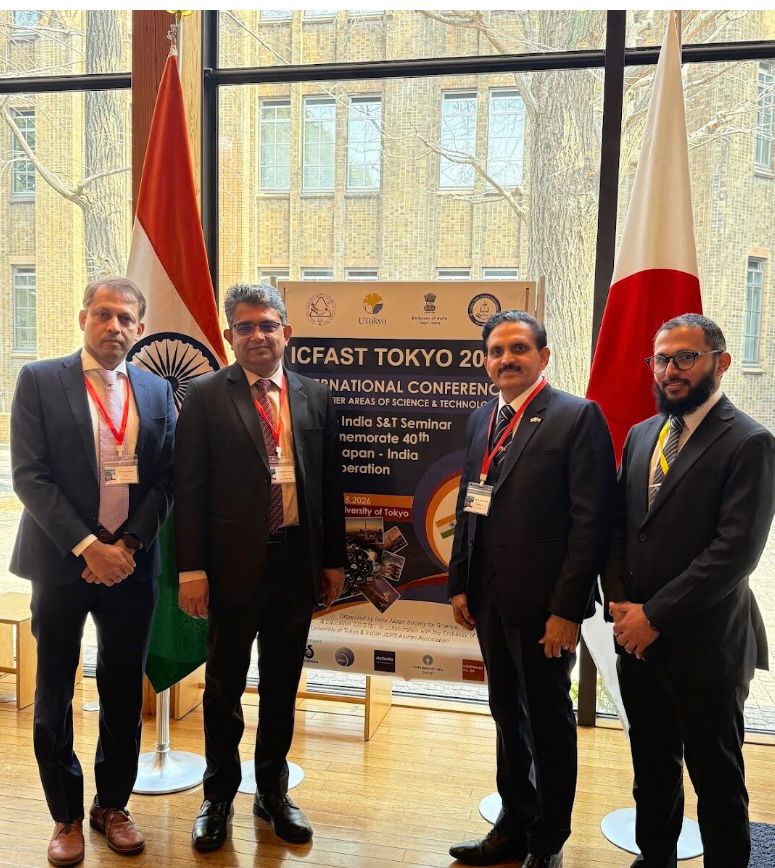
The India-Japan Science and Technology (S&T) Seminar, ICFAST TOKYO 2026, concluded successfully at the historic University of Tokyo, commemorating the 40th anniversary of India–Japan S&T cooperation. Organized by the India Japan Society for Science, Technology & Education (IJSSTE), the two-day seminar brought together more than 220 scientists, academicians, policymakers, and students from both countries.
Held on February 14–15 at Ichijo Hall, the event was organized in collaboration with the Embassy of India in Japan, the University of Tokyo, and the Indian JSPS Alumni Association. The strong participation reflected the growing momentum of bilateral academic and scientific partnerships between India and Japan.
 WhatsApp Image 2024 07 01 at 13.58.28 4cfca4e0
Inaugural Session Highlights
The seminar was inaugurated by H.E. Nagma Mallick, Ambassador of India to Japan, who lit the ceremonial lamp and delivered the inaugural address. She emphasized the importance of strengthening scientific collaboration and fostering innovation-driven partnerships for the benefit of both nations.
Prof. D. Sakthi Kumar, President of IJSSTE, welcomed the gathering and underscored the importance of sustained India–Japan cooperation in science and technology to address global challenges.
An inspiring address was delivered by Prof. Yujin Yaguchi, Vice President of the University of Tokyo, who encouraged deeper academic exchanges and collaborative research initiatives. Senior representatives from leading Japanese organizations also shared felicitation remarks, including Mr. Shiota Tsuyoshi, Executive Director of the Japan Society for the Promotion of Science (JSPS), and Mr. Ito Sotaro, Deputy Director General of the Japan Science and Technology Agency (JST), highlighting ongoing initiatives such as the Sakura Science Program.
The inaugural session concluded with a vote of thanks by Prof. Swadhin Behera, Secretary General of IJSSTE.
Distinguished Keynote Addresses
A major highlight of the seminar was the keynote address by Nobel Laureate (2015) Kajita Takaaki. Speaking on “India-Japan Collaboration in Cosmic Ray Physics,” he showcased how joint research efforts between the two nations have led to significant advancements and global scientific breakthroughs.
Dr. B. V. R. Mohan Reddy, Chairman and Founder of Cyient and Chairman of the Board of Governors of IIT Hyderabad, delivered a keynote titled “From Lab to Market: Building India-Japan Translational Research Ecosystems.” He emphasized the need to bridge academia and industry, highlighting the transformative potential of joint innovation ecosystems to benefit global society.
Closing Ceremony and Recognition
The seminar concluded with remarks by Dr. Yashwant Panwar, Science and Technology Counselor at the Embassy of India in Japan. He also presented awards for the best poster and outstanding student projects, recognizing young researchers and encouraging future collaboration.
The organizers expressed deep gratitude for the generous support extended by the Embassy of India in Japan, the University of Tokyo, JSPS, JST, and various sponsors. Special appreciation was extended to Dr. Yashwant Panwar; Prof. Swadhin Behera; Dr. P. K. Hashim; Prof. Gowda; IJSSTE members; and the dedicated Tokyo University volunteers whose collective efforts ensured the seminar’s success.
Strengthening the Future of Bilateral Research
ICFAST TOKYO 2026 not only celebrated four decades of India–Japan scientific cooperation but also laid a strong foundation for future joint research initiatives. By fostering academic exchange, encouraging innovation, and promoting youth participation, the seminar reaffirmed the shared vision of both nations to advance science and technology for global progress.
As India and Japan continue to deepen their strategic and scientific partnership, forums like ICFAST serve as vital platforms to transform ideas into impactful collaborations, shaping a stronger and more innovative future together.
Original rights to: D. Sakthi Kumar