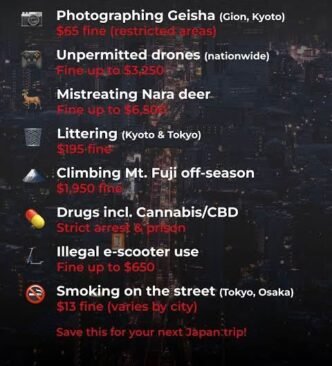
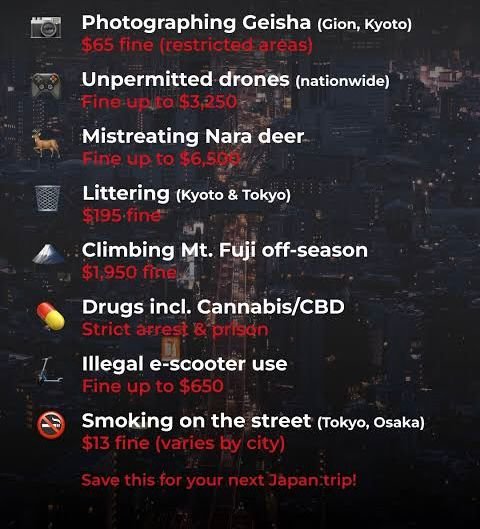
Japan welcomed a record-breaking 47 million international visitors in 2025, and the country has responded with some of the strictest tourist behaviour laws ever enforced. From Kyoto’s Gion district to the summit of Mt. Fuji, breaking these rules can cost you hundreds of dollars or even land you in jail.
This complete, up-to-date guide covers every major rule, fine, and restriction that tourists must know before visiting Japan in 2025 and 2026.
 WhatsApp Image 2024 07 01 at 13.58.28 4cfca4e0
Table of Contents
New Tourist Rules in Japan From 2025 to 2026
1. Photographing Geisha in Gion, Kyoto Now Illegal
What changed: Tourists are now banned from entering private alleys in Kyoto’s Gion district and from chasing or photographing Geisha (Geiko) without consent.
Why it happened: For years, residents and cultural workers in Gion reported being harassed, photographed without consent, and followed into private property by tourists desperate for the perfect shot. The situation became unsustainable.
The fine: ¥10,000 (approximately $65 USD) for entering restricted private streets.
What you can still do: Public streets like the famous Hanamikoji Street remain open to tourists. Popular landmarks such as Yasaka Shrine and Tatsumi Bridge are still fully accessible. The ban is specifically on private roads clearly marked with signage in both Japanese and English.
Pro tip: If you see a “No Entry” sign in Gion, it is a legally enforceable rule not a polite suggestion.
2. Entering Restricted Private Streets in Kyoto $65 Fine
What changed: Kyoto’s Gion district has installed official signage on private streets making clear that unauthorised entry carries a ¥10,000 (~$65 USD) fine.
The rule: Stick to Hanamikoji Street and all clearly marked public roads. Private alleys even if they look open may now be off-limits. Enforcement is active, especially in peak tourist seasons.
Context: Historic cities including Kyoto and Kamakura have adopted stricter visitor conduct policies, introducing both fines and access restrictions to protect residential neighbourhoods and cultural heritage sites from overtourism.
3. Drone Use Across Japan Strict New Regulations
What changed: Japan’s drone laws were significantly tightened, with enhanced enforcement active from 2025 onward.
Key rules for 2025:
- All drones weighing over 100 grams must be registered with Japan’s Ministry of Land, Infrastructure, Transport and Tourism (MLIT).
- Maximum legal flight altitude: 150 metres above ground level.
- Flying over crowds, near airports, or in urban areas without a special permit is illegal.
- Drones must remain within the pilot’s visual line of sight, during daylight only.
- Flying near Mt. Fuji is strictly regulated or completely prohibited to protect the site’s “sanctity and dignity.”
- Near cultural heritage sites, permission from the landowner is required.
Penalties: Failure to comply can result in fines or confiscation of your drone.
Important for tourists: Drone laws in Japan apply equally to tourists and residents. The registration process typically takes 3–5 business days, so plan well before your trip if you intend to fly.
4. Mistreating Nara Deer Heavy Fines Apply
What changed: Following several high-profile incidents of foreign visitors mistreating the sacred deer in Nara, authorities have cracked down significantly.
Fine: Up to ¥1,000,000 (approximately $6,500 USD) for serious animal cruelty violations under Japan’s Act on Welfare and Management of Animals.
What counts as mistreatment:
- Feeding the deer anything other than official “shika senbei” (deer crackers)
- Pulling, hitting, riding, or restraining the deer
- Chasing or cornering them for photographs
- Interfering with their natural movement
Remember: Nara’s deer are considered divine messengers (sacred animals) in Shinto tradition. They are protected by both cultural reverence and the law.
5. Littering in Kyoto and Tokyo
What changed: Enforcement of anti-littering rules has intensified in both Kyoto and Tokyo, particularly in high-traffic tourist zones.
The problem: Japan is famously clean but the surge in tourism has brought increased littering, especially near convenience stores, food stalls, and train stations where public rubbish bins are scarce.
Fines vary by city and ward, but violations can result in on-the-spot fines and even detention in serious cases.
Practical advice: Always carry a small plastic bag to hold your rubbish until you find a bin. Convenience stores (konbini) have bins for their customers use them responsibly.
6. Climbing Mt. Fuji Off-Season Now Carries a Fine
What changed: The trail between the 5th Station and the summit of Mt. Fuji is closed in accordance with Article 46 of the Road Act during the off-season (generally October through late June).
Fine: Violation can result in up to 6 months’ imprisonment or a fine of up to ¥300,000 (approximately $1,950 USD).
Why the rules exist: During the off-season, weather conditions on Mt. Fuji are severe, snowfall, avalanches, freezing temperatures, and storms are common. Mountain lodges and toilets are fully closed, mobile phone reception is extremely limited, and no rescue services are available.
For the 2025 official climbing season (July–September):
- A daily climber cap of 4,000 people is in effect on the Yoshida Trail.
- A mandatory ¥4,000 entrance fee applies on Shizuoka side trails (Fujinomiya, Gotemba, Subashiri).
- Pre-registration via the SHIZUOKA FUJI NAVI app is required.
- “Bullet climbing” (ascending overnight without resting at a hut) is prohibited.
- Climbers starting between 2 PM and 3 AM must show proof of a booked mountain hut stay.
7. Cannabis and CBD Zero Tolerance, Arrest & Prison
What changed: Japan has always had a zero-tolerance drug policy, but enforcement has become more visible as tourism rises. There is no concept of a “personal use amount” for leniency.
Cannabis: Possession of even a tiny amount can lead to up to 5–7 years in prison and immediate deportation.
CBD: May also be illegal depending on the THC content. The Japanese government decides which products are legally importable do not assume your home-country CBD product is safe to bring.
Prescription medications: Many common medications legal in other countries including Adderall, some antihistamines, certain inhalers, and Sudafed are strictly illegal in Japan. Always check with the Japanese Embassy before travelling with any medication.
Key facts from the U.S. State Department: Japanese law treats medical and recreational marijuana identically. A prescription from your home country provides no legal protection in Japan.
8. Illegal E-Scooter Use Fines Up to $650
What changed: Electric scooter services such as LUUP are now widespread in Tokyo and Osaka, but strict rules govern their use.
Rules for legal e-scooter use in Japan (2025):
- Speed limit: 20 km/h maximum
- Minimum age: 16 years (ID verification required in-app)
- Alcohol: Strictly prohibited riding after even one drink is treated the same as drunk driving a car
Fine: Up to ¥500,000 (approximately $3,200 USD) or jail for drink-riding. Fines for other violations can reach ¥100,000 (approximately $650 USD).
What to avoid: Riding on pavements/sidewalks, going over the speed limit, or using an e-scooter without a registered account.
9. Smoking on the Street in Tokyo and Osaka
What changed: Street smoking bans have been in place in parts of Japan for years, but enforcement has increased significantly and coverage has expanded.
Tokyo: In major wards including Chiyoda, smoking on the street is banned and results in an immediate fine of ¥2,000 (~$13 USD). Smokers must use designated smoking areas.
Osaka: Similar restrictions apply, with fines varying by ward and district.
General rule: Never smoke while walking anywhere in Japan. Always look for official designated smoking zones, which are usually clearly marked. Smoking inside most restaurants, cafés, and public buildings is also restricted or banned.
10. Other Important Laws Tourists Frequently Break
Street Drinking Ban Shibuya, Tokyo
As of late 2024/2025, Shibuya’s street drinking ban is in effect year-round (not just Halloween). No alcohol on streets around Shibuya Station from 6:00 PM to 5:00 AM. Police actively patrol and will confiscate your drink.
Taking Photos Up Skirts (“Skirt Photo” Law)
Japan has a specific criminal ordinance against non-consensual sexualised photography. This is why shutter sounds on Japanese smartphones are mandatory by law.
Driving With the Wrong International Driving Permit (IDP)
Japan only accepts IDPs based on the 1949 Geneva Convention. Many European countries issue IDPs under the 1968 Vienna Convention these are invalid in Japan and driving with one is treated as driving without a licence, a criminal offence.
Carrying Certain Knives
A folding knife with a blade longer than 5.5 cm is illegal to carry in public in Japan. U.S. citizens and military personnel have been arrested for this.
Overstaying Your Visa
Can result in fines, deportation, and a re-entry ban of up to 10 years (or indefinitely for drug offenders).
J-ESTA (Electronic Travel Authorisation)
From June 16, 2025, travellers from visa-exempt countries must apply for J-ESTA online before arriving in Japan. Private health insurance is also now required.
11. Japan’s 99% Conviction Rate Why These Rules Are Serious
This is not a country where you can charm your way out of a fine or beg for a warning.
- 99% conviction rate: If you are formally charged with an offence in Japan, you will almost certainly be convicted.
- 23-day detention: Police can legally hold you for up to 23 days without charge, with very limited access to a lawyer.
- Language barrier: Signs in restricted areas are now posted in English, so “I didn’t understand” is no longer a valid excuse.
Japan is one of the safest countries on Earth, and these laws exist to keep it that way for residents and respectful visitors alike.
12. Quick Reference: Japan Tourist Fines at a Glance
| Rule Broken | Location | Fine / Penalty |
| Entering restricted Gion streets | Kyoto | ¥10,000 (~$65 USD) |
| Mistreating Nara deer | Nara | Up to ¥1,000,000 (~$6,500 USD) |
| Climbing Mt. Fuji off-season | Yamanashi / Shizuoka | Up to ¥300,000 (~$1,950 USD) + 6 months jail |
| Illegal drone use | Nationwide | Fine + confiscation |
| Cannabis / CBD possession | Nationwide | Up to 7 years prison + deportation |
| Illegal e-scooter use (drink-riding) | Tokyo / Osaka | Up to ¥500,000 (~$3,200 USD) |
| Smoking on the street | Tokyo (Chiyoda ward) | ¥2,000 (~$13 USD) |
| Street drinking (Shibuya) | Tokyo | Confiscation / fine |
| Overstaying visa | Nationwide | Deportation + 10-year ban |
| Driving with invalid IDP | Nationwide | Criminal arrest |
Final Thoughts: Japan Welcomes Respectful Visitors
Japan’s new rules are not designed to push tourists away they are designed to protect the country’s extraordinary culture, wildlife, natural landmarks, and the residents who call these places home.
The good news: following these rules is genuinely easy. Stay on public streets, respect wildlife, keep your rubbish with you, and check your medications before you pack. Do that, and Japan will be one of the most rewarding travel experiences of your life.
Planning your trip? Always verify the latest requirements directly at japan.travel and the Visit Japan Web portal before departure.
Sources: U.S. State Department Japan Travel Advisory, Official Mt. Fuji Climbing Website (fujisan-climb.jp), Japan Civil Aviation Bureau (JCAB), AFAR Magazine, eTurboNews, AXA Travel Insurance Japan Tourism Guide.