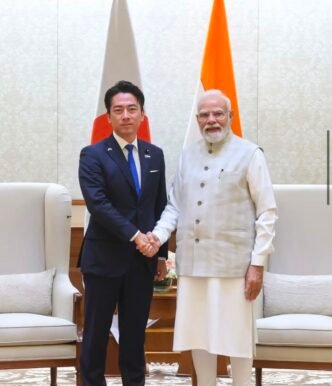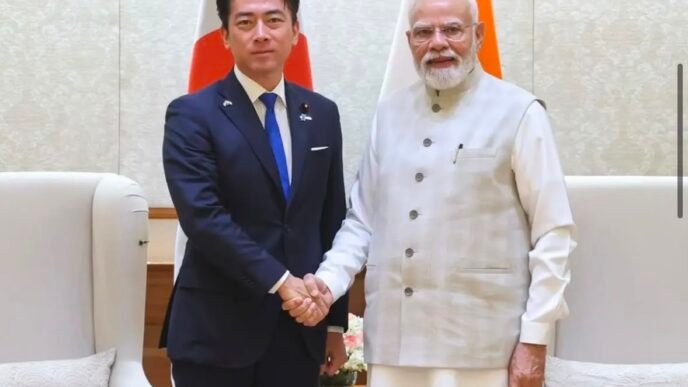
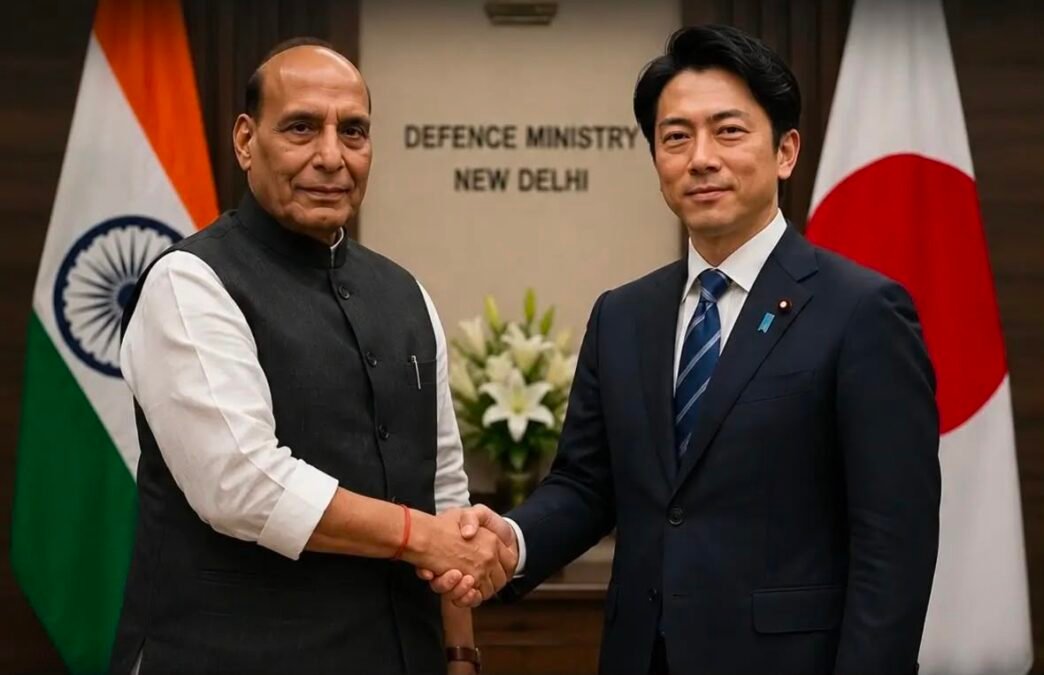
India’s Defence Minister Rajnath Singh is holding a bilateral meeting with Japan’s Defence Minister Shinjiro Koizumi in New Delhi on August 20, 2026, as the two countries seek to further strengthen their defence and strategic partnership.
The talks are focused on bilateral defence cooperation, maritime security and defence equipment and technology collaboration under the ‘Make in India’ framework. The meeting comes at a time when India and Japan are expanding cooperation to address evolving security challenges across the Indo-Pacific.
 WhatsApp Image 2024 07 01 at 13.58.28 4cfca4e0
Strengthening India-Japan Defence Cooperation
The meeting between Rajnath Singh and Shinjiro Koizumi represents another step in the development of the India-Japan Special Strategic and Global Partnership.
Both countries have been working to expand defence cooperation through high-level dialogues, military exercises, maritime engagement and technology collaboration.
The two ministers are expected to explore new avenues for cooperation while strengthening strategic trust and coordination between their defence establishments.
Maritime Security Takes Centre Stage
Maritime security is a major component of the India-Japan strategic relationship.
Both countries have a shared interest in maintaining secure sea lanes, freedom of navigation and a stable maritime environment across the Indo-Pacific.
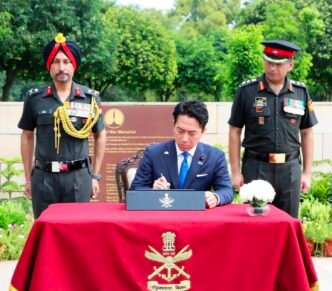
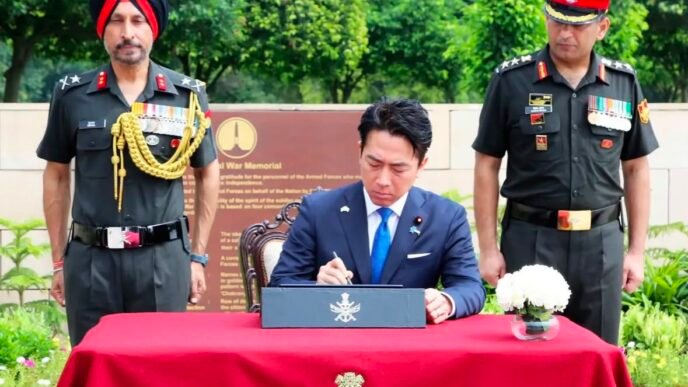
Koizumi’s visit comes with a strong naval focus. Before travelling to New Delhi, he visited the Indian Navy’s Western Naval Command in Mumbai on August 19, where he met Chief of the Naval Staff Admiral Krishna Swaminathan and Western Naval Command chief Vice Admiral Sanjay Vatsayan.
He also visited the indigenous guided-missile destroyer INS Chennai, reviewed operational capabilities, received a Guard of Honour and laid a wreath at the Gaurav Stambh memorial.
Focus on Defence Equipment and Technology
A key area of the discussions is defence equipment and technology cooperation.
India and Japan have been exploring ways to expand collaboration in advanced defence technologies and strengthen industrial cooperation under India’s Make in India initiative.
The relationship is increasingly moving beyond traditional defence dialogue towards co-development, co-production and technology partnerships.
Japan’s defence equipment transfer framework was revised earlier in 2026, creating greater scope for cooperation with trusted partners. Japan’s Ministry of Defense has specifically noted expectations for the transfer of the UNICORN system to India to move forward.
UNICORN and Advanced Naval Technology
The UNICORN naval communication system has emerged as an important element of India-Japan defence technology cooperation.
The system is designed to support secure naval communications while reducing the radar signature associated with conventional antenna arrangements.
Its potential transfer to India reflects the growing technological dimension of the bilateral defence relationship and could provide opportunities for deeper cooperation in naval systems, communications and defence manufacturing.
The discussions are also taking place against the backdrop of growing interest in unmanned systems and advanced technologies, areas in which both countries are seeking to strengthen their capabilities.
Japan’s Defence Equipment Policy Creates New Opportunities
Japan has traditionally maintained strict controls on defence equipment and technology transfers. However, Tokyo revised its framework in April 2026.
The change is significant for India-Japan defence cooperation because it can create additional opportunities for technology transfer, industrial partnerships and joint development.
Japan’s Ministry of Defense said in July that the two countries were discussing further areas of Defence Equipment and Technology Cooperation following the leaders’ summit and Japan’s revised transfer framework.
Building Defence Manufacturing Partnerships
For India, deeper cooperation with Japan also supports the broader objective of developing a self-reliant defence manufacturing ecosystem.
The Make in India framework encourages greater domestic production, technology transfer and participation by Indian industry.
Japanese expertise in precision engineering, electronics, naval technology and advanced manufacturing could complement India’s expanding defence-industrial capabilities.
The partnership could therefore create opportunities not only for equipment acquisition but also for joint production, technology development and industrial cooperation.
A Shared Vision for the Indo-Pacific
India and Japan share a broader strategic interest in maintaining a free, open, resilient and prosperous Indo-Pacific.
Their cooperation reflects common concerns about maritime security, freedom of navigation and the importance of a rules-based regional order.
As the strategic environment across the Indo-Pacific becomes increasingly complex, closer coordination between the two countries is gaining greater significance.
Expanding Cooperation Beyond Traditional Defence
The India-Japan defence relationship has steadily expanded beyond military-to-military exchanges.
The countries are now exploring cooperation involving:
- Maritime security
- Defence equipment and technology
- Unmanned systems
- Naval communications
- Joint development and production
- Advanced manufacturing
- Strategic coordination
- Indo-Pacific security
This broader approach reflects the changing nature of modern defence partnerships, where technology, industrial capacity and strategic planning are increasingly interconnected.
Why This Matters
1. Strengthening Maritime Security
Closer India-Japan cooperation can contribute to greater maritime security across the Indo-Pacific.
2. Advancing Defence Technology
Technology partnerships can provide opportunities for India and Japan to work together on advanced defence systems.
3. Supporting Make in India
Greater Japanese participation can contribute to domestic defence manufacturing, technology transfer and industrial development.
4. Expanding Naval Cooperation
The focus on maritime security and systems such as UNICORN highlights the growing importance of naval cooperation.
5. Strengthening the Indo-Pacific Partnership
Closer defence ties between India and Japan can support their shared objective of a free, open and resilient Indo-Pacific.
Final Word
The meeting between Rajnath Singh and Shinjiro Koizumi marks another important moment in the rapidly developing India-Japan defence partnership.
With maritime security, advanced defence technology, equipment cooperation and Make in India at the centre of discussions, the relationship is moving towards deeper and more practical defence-industrial cooperation.
Koizumi’s visit to the Indian Navy’s Western Naval Command and INS Chennai further underlines the growing maritime dimension of the partnership. Meanwhile, Japan’s revised defence equipment transfer framework could open new avenues for cooperation in areas such as naval communications, unmanned systems and advanced defence technologies.
As India and Japan continue to coordinate more closely on regional security, the partnership could become an increasingly important pillar of stability and resilience across the Indo-Pacific.