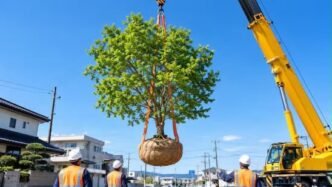
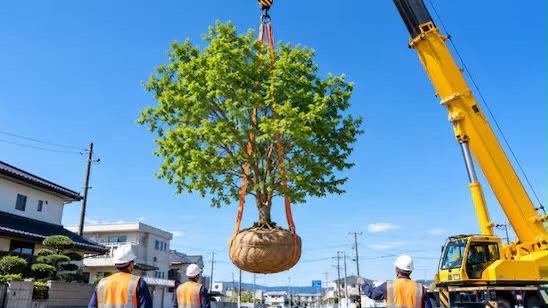
When an old tree stands in the path of a road, building or redevelopment project, cutting it down can seem like the simplest solution. In Japan, however, some valuable trees are given another option: move them instead of removing them.
The process can take months or even longer. Specialists prepare the tree’s root system in advance, carefully move it with a substantial root ball and then continue monitoring it after transplantation. The technique is known as nemawashi, a traditional Japanese horticultural practice meaning roughly “going around the roots.”
 WhatsApp Image 2024 07 01 at 13.58.28 4cfca4e0
Nemawashi involves preparing a tree’s roots before the actual transplantation.
Instead of suddenly removing a large portion of the tree’s root system, specialists gradually work around the roots and prune selected sections. This encourages the tree to develop new, smaller feeder roots closer to the trunk.
These roots are important because they help the tree absorb water and nutrients. Preparing them beforehand can reduce the stress associated with transplantation.
Moving a mature tree is not a quick operation.
Depending on the species, size and condition of the tree, root preparation can take several months and, in some cases, considerably longer. A Japanese specialist landscaping company notes that large-tree root preparation may require one to two years to encourage sufficient new root growth.
Once the tree is ready, it can be carefully excavated, moved and replanted at its new location.
Not every tree affected by construction is suitable for relocation.
The technique is generally considered for trees with particular historical, cultural, ecological or landscape value. Trees around temples, shrines, gardens, parks and historic areas can be especially significant to local communities.
Relocating a mature tree can preserve part of an established landscape while allowing development to continue.
Tokyo’s Jingu Gaien redevelopment provides a real-world example of the detailed planning involved in tree transplantation.
The project’s official information says trees considered for transplantation undergo root preparation, soil assessment and other measures before being moved. Tree doctors are involved in the process, while irrigation and appropriate planting conditions are planned to support the trees after transplantation.
The project also states that trees that cannot be safely transplanted because of factors such as poor vitality or insufficient space for root preparation may have to be removed instead.
Moving a Tree Does Not Guarantee Survival
The idea may sound almost magical, but transplantation carries significant risks.
Research examining mature transplanted trees in Hong Kong found that approximately 77% recovered fully, while others died or experienced serious decline. The study involved trees mostly 25–50 years old, demonstrating that even mature trees can face substantial transplant shock.
That is why experts consider factors such as species, season, root condition, soil quality and the length of preparation before deciding whether relocation is practical.
The practice highlights a broader idea about construction and conservation: development does not always have to mean removing everything that already exists.
For particularly valuable trees, careful planning can sometimes allow infrastructure projects and preservation efforts to coexist.
Why This Matters
1. Preserving Living History
Some mature trees are more than landscaping—they can be part of a site’s cultural and community identity.
2. Protecting Established Landscapes
Relocation can help retain mature greenery instead of replacing it entirely with newly planted trees.
3. Traditional Knowledge Meets Modern Expertise
Nemawashi combines long-established horticultural knowledge with modern soil assessment, irrigation and tree-health monitoring.
4. A Slow Alternative to Removal
The process shows that saving a mature tree can require significantly more planning, time and technical expertise than simply cutting it down.
Japan’s approach to valuable mature trees is not simply “never cut a tree.” Rather, it is about determining whether a tree can realistically be preserved and, when possible, preparing it carefully for a new home.
From months of root preparation to post-transplant monitoring, nemawashi demonstrates how patience and specialist knowledge can give some of the world’s oldest living landmarks another chance to survive alongside modern development.