
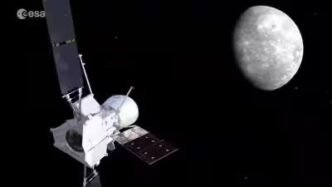
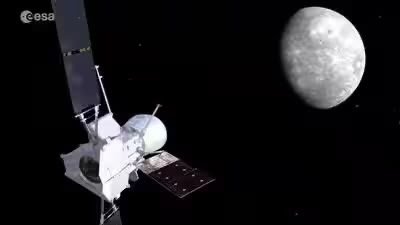
BepiColombo Makes Historic Arrival at Mercury
The joint Japan-Europe space mission BepiColombo has successfully entered Mercury’s orbit after an extraordinary eight-year journey covering more than 10 billion kilometres.
 Asahi Travel Service Pvt Ltd
The European Space Agency (ESA) confirmed the spacecraft’s orbital capture on November 21, 2026, marking a major milestone in international space exploration. The mission is a collaboration between ESA and the Japan Aerospace Exploration Agency (JAXA), aimed at uncovering the mysteries of the Solar System’s smallest planet.
BepiColombo is only the second mission in history to enter orbit around Mercury, following NASA’s MESSENGER spacecraft.
An Eight-Year Journey Through Space
BepiColombo was launched on October 20, 2018, from Europe’s spaceport in French Guiana aboard an Ariane 5 rocket.
Reaching Mercury required a complicated route through the inner Solar System. Instead of travelling directly towards the planet, the spacecraft used gravitational assistance from other planets to gradually adjust its speed and trajectory.
During its journey, it completed nine planetary flybys: one of Earth, two of Venus and six of Mercury. These manoeuvres helped the spacecraft manage the Sun’s powerful gravitational pull and prepare for its final orbital insertion.
The successful arrival followed a critical engine manoeuvre designed to slow the spacecraft sufficiently for Mercury’s gravity to capture it.
Two Spacecraft to Explore Mercury
One of the mission’s most important features is its two scientific orbiters, developed by different space agencies.
● Mercury Planetary Orbiter (MPO): Developed by ESA, it will closely examine Mercury’s surface, composition and internal structure.
● Mio (Mercury Magnetospheric Orbiter): Developed by JAXA, it will investigate the planet’s magnetic field and its interaction with the solar wind.
The two spacecraft are scheduled to separate on December 9–10, 2026, and begin operating in different orbits around Mercury.
By studying the planet from two different distances, scientists hope to collect complementary information that could provide a deeper understanding of its environment.
Uncovering Mercury’s Biggest Mysteries
Despite being the closest planet to the Sun, Mercury remains one of the least explored worlds in the Solar System.
Scientists hope BepiColombo will help answer several important questions, including why Mercury has an unusually large metallic core, how its magnetic field works and how its surface evolved over billions of years.
The mission will also investigate mysterious surface formations known as hollows and examine the possibility of water ice inside permanently shadowed polar craters.
Mercury experiences extreme temperature variations, with some regions reaching around 430°C during the day while permanently shadowed areas can remain extremely cold. Understanding how ice survives in such an environment is one of the mission’s major scientific goals.
Scientific Operations Expected in 2027
Although BepiColombo has reached Mercury’s orbit, its scientific work will continue through several important manoeuvres and spacecraft separations.
The mission’s main scientific observation phase is scheduled to begin in April 2027. Researchers expect the combined findings from the European and Japanese orbiters to provide valuable information about Mercury’s geological history, magnetic environment and formation.
The mission also represents an important achievement in international cooperation, bringing together scientific and engineering expertise from Europe and Japan.
BepiColombo’s arrival at Mercury marks a remarkable achievement after eight years and more than 10 billion kilometres of travel. With ESA and JAXA preparing to operate two scientific orbiters around the planet, the mission could transform our understanding of Mercury and provide new insights into how planets form and evolve.