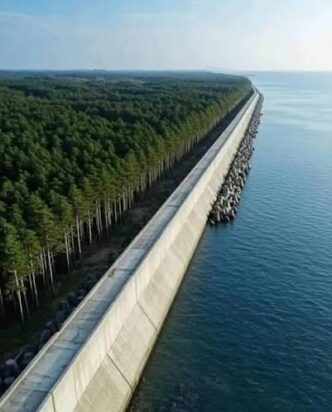
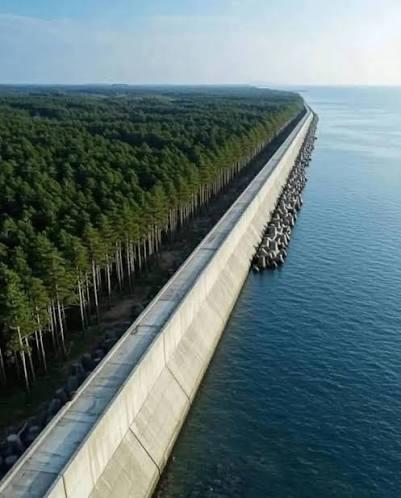
Japan Tsunami Wall: When the 9.0-magnitude Tōhoku earthquake struck Japan in March 2011, the tsunami that followed rewrote the country’s understanding of coastal safety. Waves higher than buildings overwhelmed towns, swept away entire neighbourhoods, and claimed nearly 20,000 lives. In the aftermath, Japan made a defining choice: instead of rebuilding the past, it would redesign the future of coastal defense.
The result is one of the most ambitious disaster-prevention projects ever attempted: a 395-kilometre network of tsunami walls combined with large-scale ecological restoration. Rather than relying on a single barrier, Japan adopted a multi-layered coastal defense strategy that assumes nature can never be fully controlled, only slowed and survived.


What Exactly Did Japan Build?
Across the most vulnerable coastlines of Iwate, Miyagi, and Fukushima, Japan constructed approximately 395 km of tsunami walls. These structures are not uniform; their height and design vary according to local risk assessments.
- Wall heights range from 5 metres to over 14 metres, depending on predicted tsunami intensity
- Built from reinforced concrete, engineered to withstand extreme water pressure and debris impact
- Designed using worst-case tsunami simulations, not just historical averages
Unlike older seawalls meant for storm surges, these barriers are specifically designed to buy time, reducing the initial force of incoming waves so people can evacuate.
Why Plant 9 million Trees for Japan Tsunami Wall?
Japan’s planners knew concrete alone would not be enough. Alongside the walls, the government restored and expanded coastal forests, planting an estimated 9 million trees, including pine and other deep-root species.
These forests serve multiple life-saving functions:
- Natural shock absorbers that slow tsunami speed
- Debris filters that trap floating wreckage and reduce impact damage
- Erosion controllers that stabilize coastal soil
- Secondary protection if water overtops the walls
This combination of hard engineering and natural systems forms the backbone of Japan’s layered defense approach.
How the System Works in Real Time
Japan’s coastal protection is not a single line of defense, but a chain of safeguards designed with failure in mind.
- Early-warning systems detect earthquakes within seconds
- Seawalls absorb and deflect the first wave impact
- Coastal forests slow down residual water and debris
- Elevated evacuation routes and shelters protect residents even if barriers are breached
The philosophy is simple but powerful: assume every layer could fail, and plan backups accordingly.
Cost and Controversy
The scale of the project came with a staggering price tag of an estimated ₹7.6 — 8 lakh crores (USD 50–70 billion). It also sparked debate within coastal communities.
Critics argue the walls:
- Block ocean views
- Affect fishing livelihoods
- Reduce tourism appeal
Supporters counter that:
- Thousands of lives could be saved
- Cities gain crucial reaction time during disasters
- Infrastructure and economic losses are significantly reduced
In the end, Japan made a clear choice: prioritize safety over aesthetics.
Why the World Is Watching Japan
As climate change intensifies storms and raises sea levels, Japan’s approach is attracting global attention.
- Countries such as Indonesia, Chile, and the Philippines are studying the model
- Disaster planners increasingly advocate “hybrid defenses” combining engineering with nature rather than choosing one over the other
Japan’s response to tragedy is now shaping how the world thinks about coastal survival.
Final Thought
Japan did not try to defeat nature.
It chose to slow it, absorb it, and live with it.
The country’s tsunami walls and forests stand as a reminder that resilience is not about absolute protection, it is about buying time, reducing impact, and saving lives.
The question for coastal nations remains:
Should they invest in massive protective infrastructure like Japan, or focus more on relocation and early-warning systems?
As Japan’s experience shows, the answer may lie not in choosing one path but in combining them wisely.
Originally written by: Yash Sisodia