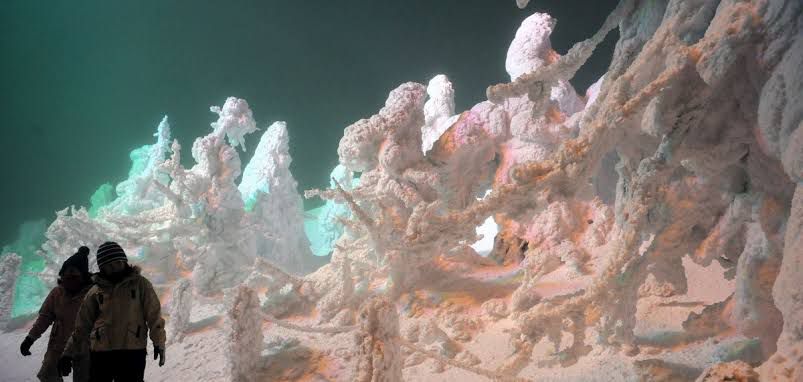
High in the snowbound mountains of northern Japan, a natural spectacle appears each winter that seems pulled straight from a fantasy film. Towering, ghostly white figures rise from the frozen slopes, shaped like giants standing guard over the landscape. Locals call them “snow monsters” but in reality, these striking forms are ice-covered trees, a rare and fragile natural wonder now facing a serious threat.
As climate change accelerates and weather patterns shift, Japan is racing to protect one of its most unique winter treasures.


What Are Japan’s ‘Snow Monsters’?
Known locally as “Juhyo”, the snow monsters are not creatures at all but Aomori fir trees completely encased in layers of snow and ice. They form only under extremely specific conditions:
- Moist air from the Sea of Japan
- Strong winter winds
- Constant sub-zero temperatures
- Heavy snowfall over several weeks
As freezing mist and snow repeatedly stick to the trees, they slowly transform into thick, sculptural shapes that resemble frozen beasts towering over the mountains.
This phenomenon occurs most famously on the slopes of Mount Zao, straddling Yamagata and Miyagi prefectures. Very few places in the world offer the exact conditions needed to create such formations, making Japan’s snow monsters truly irreplaceable.
A Disappearing Winter Wonder
For generations, the snow monsters have drawn tourists, photographers, and scientists from around the world. However, experts now warn that these iconic formations are becoming smaller, weaker, and less predictable.
The reason: climate change.
Winters in northern Japan are growing warmer. Snowfall is becoming inconsistent, and freezing fog—essential for the monsters to form now arrives later and disappears earlier. Some winters now produce only partial formations, while others create none at all.
Scientists fear that without drastic environmental stabilization, the snow monsters could become a rare memory rather than a yearly marvel.
Why Their Loss Matters
The disappearance of the snow monsters would be more than just a loss of beauty. Their impact reaches many layers of Japanese life:
- Cultural heritage: They are a powerful symbol of Japan’s extreme winters and natural beauty.
- Local economy: Winter tourism connected to snow monster viewing supports hotels, ski resorts, transport workers, and small businesses.
- Scientific value: The formations help researchers study ice accumulation, wind behavior, and climate patterns.
- Environmental warning: Their decline is a visible sign of broader climate disruption.
The Fight to Save the Snow Monsters
Local governments, researchers, and environmental groups have launched multiple efforts to protect the fragile ecosystem that allows the snow monsters to form.
Key measures include:
- Forest protection programs to preserve the native fir trees
- Controlled tourism policies to limit damage caused by foot traffic and vehicles
- Climate research stations monitoring temperature, wind, and snow behavior
- Public awareness campaigns encouraging sustainable travel and environmental responsibility
Some ski resorts have also adjusted operations to reduce emissions and ecological strain in sensitive zones.
Balancing Tourism and Preservation
Tourism is both a blessing and a risk. Each year, thousands of visitors travel to Mount Zao for nighttime illuminations, ropeway rides, and winter festivals built around the snow monsters. While this supports the regional economy, it also increases pressure on an already delicate environment.
Authorities are now working to limit visitor numbers during peak periods, promote off-season travel, and ensure that viewing areas remain protected from erosion and forest damage.
The goal is not to stop tourism but to ensure that it does not destroy what people come to see.
Voices from the Mountains
Local residents who grew up with the snow monsters speak with a mix of pride and fear.
“Every winter they had different shapes,” says one mountain guide. “Some looked like warriors, some like animals. Now, some years, they barely appear at all. It feels like losing an old friend.”
For these communities, the snow monsters are not just a tourist attraction they are part of identity and memory.
A Global Message Frozen in Ice
Japan’s snow monsters now serve as a powerful global symbol. Their gradual disappearance mirrors what is happening to glaciers, coral reefs, and polar ice worldwide. Though silent and motionless, these frozen figures send a loud warning: Nature’s balance is shifting.
Hope Still Remains
Despite the threats, experts believe the snow monsters can still be protected if climate action is taken seriously. Reducing emissions, preserving natural forests, and promoting responsible tourism could allow future generations to witness this rare winter miracle.
For now, when the fog freezes and the wind sculpts the trees once again into towering white shapes, visitors stand in awe knowing they are witnessing something that exists almost nowhere else on Earth.
And that is exactly why Japan is fighting to save its snow monsters before they disappear forever.
Originally written by: Mizuki Uchiyama
Link to the article: https://www.bbc.com/future/article/20251203-japans-disappearing-snow-monsters