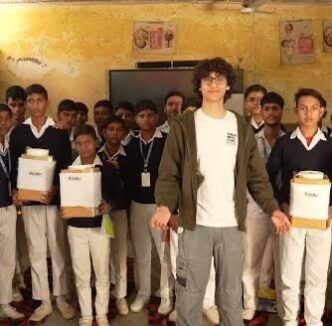
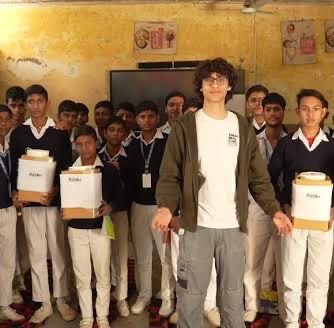
In a city where stepping outside can feel like inhaling smoke, where children grow up with inhalers before they learn to ride bicycles, 17-year-old Aarkin Soni decided that silence was no longer an option. While millions in Delhi breathe toxic air every day, Aarkin chose to fight back—not with protests or petitions, but with a cardboard box, a HEPA filter, and an unshakable belief that clean air is a human right.
What he built would soon become FiltAir, a low-cost, DIY air purifier that now protects young lungs and changing futures.
 WhatsApp Image 2024 07 01 at 13.58.28 4cfca4e0
A City Choking, A Teen Who Refused to Look Away
Delhi consistently ranks among the world’s most polluted cities. Every winter, a toxic blanket of smog settles over its streets, pushing air quality into the “hazardous” zone. Schools shut down, hospitals overflow, and children suffer the most—developing asthma, bronchitis, and long-term respiratory disorders before they turn into teenagers.
Aarkin witnessed this reality not through statistics, but through everyday life: classmates coughing through lessons, younger children struggling to breathe, families unable to afford expensive air purifiers that cost more than a month’s income.
“That’s when it hit me,” he recalls. “If clean air is only for people who can afford it, then something is very wrong.”
With no lab, no funding, and no formal engineering training, Aarkin turned to what he had curiosity, online research, and household materials. Using a HEPA filter, a simple fan, and a reinforced cardboard frame, he created his first working air purifier.
It wasn’t fancy. It wasn’t sleek.
But it worked.
The cost? Just ₹2,500 (around £2,500 as per early project valuation) a fraction of what commercial air purifiers demand. For families choosing between healthcare and rent, this difference was life-changing.
That first prototype soon became FiltAir a symbol of what young minds can achieve when driven by purpose instead of profit.
What began as a personal experiment quickly turned into a movement. Instead of selling the purifiers, Aarkin made a bold decision: he would teach others to build them.
Today, he conducts hands-on workshops in Delhi’s government schools, guiding students many from low-income families through the entire process of building their own air purifiers. They learn:
● How air pollution affects the lungs
● How filtration works
● How simple innovation can solve real-world problems
For many of these children, it’s their first experience of building something that directly protects their own health and that of their families.
“I don’t want them to depend on products,” Aarkin says. “I want them to depend on their own skills.”
In a society where air purifiers are marketed as premium lifestyle products, FiltAir challenges the narrative. It reframes clean air not as a commodity but as a basic right.
Doctors observing the initiative have noted reduced indoor particulate levels in classrooms using the DIY purifiers. Parents report fewer night-time coughs. Teachers say students concentrate better.
But beyond data and outcomes, the biggest shift is psychological:
Children who once felt helpless against pollution now feel empowered.
A New Generation of Problem-Solvers
Aarkin’s story is not just about pollution it’s about what happens when the youth stop waiting for solutions and start creating them.
He is now working with local educators and environmental groups to expand the workshops across more schools. His long-term dream is to build a nationwide student-led network where young innovators tackle daily survival challenges from clean air to clean water.
“I didn’t build FiltAir because I’m special,” he says. “I built it because I was angry that something so basic was being taken away from us.”
Aarkin Soni is one story but he represents a rising generation of Indians who refuse to normalize crisis. In the middle of toxic smog and broken systems, he chose action over apathy, solution over surrender.
This is Breathe Better India a reminder that heroes don’t always wear uniforms or work in laboratories. Sometimes, they carry cardboard boxes, teach kids how to build, and quietly change the air we breathe.
And in doing so, they change the future.
Originally by: The Better India