
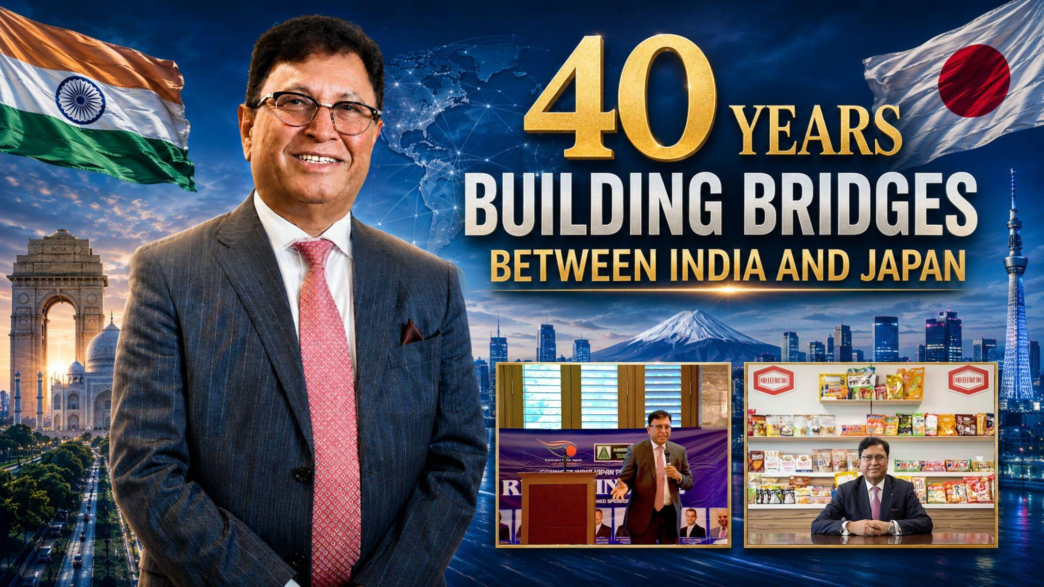
Tokyo, Japan: Speaking at the Rising India 2 India-Japan Business Conclave at the Akasaka Prince Classic House in Tokyo, Dr. Lekh Juneja, Chairman of the Kameda Seika Group, delivered one of the most personal and wide-ranging addresses of the day — part autobiography, part business philosophy, and a genuine tribute to four decades spent building between two nations.
A Rare Choice in 1984
Dr. Juneja arrived in Japan in 1984 on a fellowship in biotechnology — at a time, he recalled, when almost no Indian students chose Japan over America or Europe. What drew him in, he said, was a simple phrase: “Made in Japan.” Even decades later, he told the audience, that standard of excellence remains unmatched. “Nobody could beat it forty years ago. Nobody can beat it today.”
 WhatsApp Image 2024 07 01 at 13.58.28 4cfca4e0
He spoke candidly about what struck him most in his early years in Japan — not just the quality of its products, but the safety of its streets, and a culture defined as much by its people as by its technology.
Watching Japan’s Economic Rise and Plateau
Dr. Juneja offered a sobering reflection on Japan’s economic trajectory. When he arrived, Japan was widely expected to become the world’s largest economy, with twelve Japanese companies in the Forbes Global rankings and fifteen Japanese firms among the world’s top twenty. Today, he noted, only a handful remain near the top, even as the fundamentals — the people, the craftsmanship, “Made in Japan” itself — have not changed. What has changed, he said, is the world’s perception, with countries like India and China now commanding the global economic conversation Japan once led alone.
He pointed to Suzuki’s deep, early investment in India — and Mr. Toshihiro Suzuki’s continued leadership today — as a powerful example of the kind of conviction needed to compete globally: “That’s guts,” he said.
Sunfiber: A Story of Japanese Technology and Indian Raw Materials
Among the highlights of his address was the story of Sunfiber, a dietary fiber product Dr. Juneja helped develop thirty years ago using guar gum sourced from India, combined with Japanese technological expertise. Today, Sunfiber is used by major global food companies including Nestlé and Danone. “Japanese technology and Indian raw materials — that combination can sell to the world,” he said, calling it proof of what collaboration between the two nations can achieve.
He also shared a striking detail about Japan’s relationship with food: the Japanese language has 445 words to describe food texture, compared to just 77 in English — a reflection, he said, of the precision and sensitivity that defines Japanese craftsmanship.
A Story About Ratan Tata
In one of the more memorable moments of his address, Dr. Juneja recounted meeting the late Ratan Tata, and introducing him to Japanese eye drops — a product, he explained, virtually unique to Japan, with no real equivalent culture of use in India. Tata, he said, was so taken with the idea that he expressed a wish to introduce eye drops to every driver of Tata’s vehicles across India. The encounter, Dr. Juneja said, became the beginning of a relationship that led him to invest in ventures bridging Japan and India.
The First Indian Board Director of a Listed Japanese Company
Dr. Juneja is believed to be the first Indian to be appointed a board director of a publicly listed Japanese company — a milestone, he noted, that drew significant media attention in Japan at the time, underscoring just how rare such representation still is.
He closed his address by reflecting on the Japanese philosophy of 一期一会 — ichi-go ichi-e, the idea that every encounter is a once-in-a-lifetime opportunity, never to be repeated in exactly the same way. It is a philosophy, he said, that has guided his entire journey in Japan: a chance fellowship in 1984, a chance meeting with Ratan Tata, and four decades spent turning isolated encounters into a lasting bridge between two nations.
Rising India 2 was organised by Connect India Japan, a platform dedicated to strengthening bilateral relations between India and Japan. The conclave was held on June 17, 2026 at the Akasaka Prince Classic House, Tokyo.