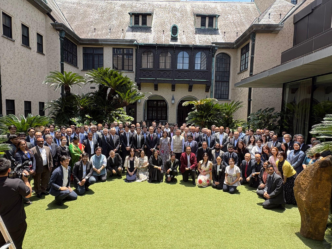

TOKYO, June 17, 2026 — History was made in Tokyo today, as Connect India Japan (CIJ), founded and led by Indian entrepreneur Nupur Tewari, convened Rising India 2, its landmark India-Japan Business Conclave, at the storied Akasaka Prince Classic House — a venue that has hosted royalty, heads of state, and some of the most distinguished gatherings in Japanese public life.
For the first time, a sitting Finance Minister of Japan, a Member of the House of Councillors, the Ambassador of India to Japan, the President of Suzuki Motor Corporation, and senior figures spanning Japan’s diplomatic, defence, and policy establishment shared a single stage — before a packed audience of more than 150 attendees drawn from Indian and Japanese business, government, and industry.
 WhatsApp Image 2024 07 01 at 13.58.28 4cfca4e0
The day opened with an inaugural dance performance, setting a celebratory tone for a full day of keynote addresses, panel discussions, and curated networking that included an exclusive lunch and an evening networking dinner.
Japan’s Finance Minister Sounds the Call for Partnership in a Fragmenting World.
The marquee address of the day came from H.E. Ms. Satsuki Katayama, Finance Minister of Japan, whose presence at a bilateral business conclave of this nature was itself unprecedented. She opened by thanking the organizers and the audience for their commitment to the India-Japan relationship, and welcomed the world’s recent peace agreements in the Middle East.
Her message, however, carried a weight that went beyond ceremony. The world today, she said, stands at a major turning point — an environment made more complex than ever by geopolitical tensions, uncertainty over trade, climate change, and the pace of technological innovation. Some, she observed, now describe this as a world heading toward fragmentation. Against that backdrop, her conclusion was unambiguous: cooperation between partners who share common values and interests has never mattered more.

It was a statement that gave the entire day’s gathering its defining purpose — and it was delivered by Japan’s Finance Minister from a stage built by an Indian entrepreneur in Tokyo.
Suzuki’s President: “We Will Continue to Walk Alongside Bharat”

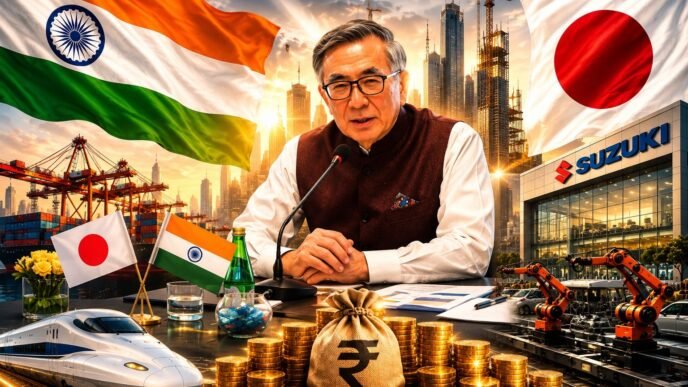
Mr. Toshihiro Suzuki, Representative Director and President of Suzuki Motor Corporation, took the stage to speak not as a corporate leader delivering a report, but as someone whose company’s story is inseparable from India’s own modern history.
He traced the journey back to 1982, when Suzuki entered into a joint venture with the Government of India and launched the Maruti 800 — the first car for millions of Indian families, he said, a vehicle that offered affordable mobility, built trust in technology, supported the growth of the middle class, and became part of India’s modern story. He noted with evident feeling that Ambassador Nagma Mohamed Mallick’s own family had owned a Maruti Omni as their first car — a reminder, he said, that Suzuki’s cars are not merely products, but companions in the daily lives of Indian families.
The numbers he presented were striking in their scale. In FY2025, Maruti Suzuki achieved record-high production of 2.35 million units — a volume matched under a single brand in a single country by only a handful of companies in the world, including Toyota and BYD. Exports reached approximately 448,000 units, also a record, with vehicles shipped to markets across Africa, the Middle East, and beyond — embodying, he said, the national vision of “Make in India, Make for the World.”
He closed with a commitment that drew the room’s attention: Suzuki currently touches the lives of approximately 400 million people in India. The next challenge, he said, is to grow alongside the “Next Billion” — the vast population advancing to the next stage of India’s development. “We will continue to walk alongside Bharat,” he said, “contributing to its development and the prosperity of its people, and building a sustainable future together.”

In recognition of his decades-long contribution to strengthening ties between the two nations, Connect India Japan presented Mr. Suzuki with the India-Japan Excellence Award — a fitting tribute to a leader whose company has done as much as any single enterprise to bridge the aspirations of both countries.
A Lawmaker’s Voice from the Halls of Power

H.E. Mr. Keiichiro Asao, Former Minister of the Environment and a sitting Member of the House of Councillors, opened with a personal reflection on his own ties to India — a single visit, some forty years ago, made as a high school student after winning a Prime Minister’s award for an essay on economic cooperation, when he traveled through Calcutta and Delhi. He recalled asking Mr. Suzuki backstage whether the old Ambassador car still existed on Indian roads, only to learn it does not — a small detail, he said, that captured just how much India has transformed since.
Turning to policy, Mr. Asao drew on Japan’s own development history — including the pollution that followed weak environmental regulation during its earlier industrial growth — to argue that India can pursue economic growth while protecting its environment, from water quality to air pollution, by drawing on Japanese technology and experience. He pointed to the Joint Crediting Mechanism (JCM) agreed between Japan and India during Prime Minister Modi’s visit to Japan last year, under which emissions reductions achieved using Japanese-financed technology are shared between the two countries, and highlighted Japan’s lesser-known strength in punctual urban rail systems as a potential solution to the traffic congestion and emissions India may face as it develops.
He closed by describing his work as Environment Minister on a roadmap for artificial photosynthesis — using sunlight to convert carbon dioxide and water vapor into ethanol and other fuels — with a goal of bringing such fuel to market more cheaply than bioethanol by 2040, and expressed hope that Japan and India could collaborate on that frontier as well.
India Invites Japan Into Its Growth Story: Ambassador Mallick’s Call to Action

H.E. Ms. Nagma Mohamed Mallick, Ambassador of India to Japan, opened the conclave with an address that was equal parts data, conviction, and invitation — one that reframed India not as a country seeking investment, but as a proven partner offering a once-in-a-generation opportunity.
She spoke of India’s extraordinary diversity — from north to south, east to west — and argued that the country has turned that diversity into its defining strength, enshrined in a constitutional commitment to inclusivity and representation for every individual. With a median age of 28.5 years, India holds the youngest working-age population in the world, she noted, backed by a large and growing pool of STEM graduates who serve as a force multiplier for the economy.
The numbers she brought were striking. Japan is the fifth largest investor in India, with approximately $45 billion invested over the past 25 years — and a recent Japanese government report found that 76 percent of Japanese companies operating in India have recorded good and rising profits. Around 1,500 Japanese companies run over 5,200 business establishments across India today, spanning automobiles, electronics, engineering, chemicals, logistics, and services. The three major Japanese banks have recently entered India’s financial sector — investing directly in retail banking, home loans, and rural credit — a move the Ambassador described as a testament to the trust India’s regulators extend to Japan.
She singled out Mr. Toshihiro Suzuki in the room and spoke directly to what his company’s early bet on India had meant. Those who planted seeds in India decades ago — factories, training centres, supplier networks, technical institutes — are today watching those trees bear fruit.
Her vision for the road ahead was anchored in the eight pillars agreed upon at the 15th India-Japan Annual Summit: next-generation economic partnership, economic security, clean energy, smart mobility, ecological sustainability, technology and innovation, health cooperation, and people-to-people exchanges — with an ambition of 500,000 personal exchanges between the two countries. She pointed to flagship projects — the Mumbai-Ahmedabad High Speed Rail, the Delhi-Mumbai Industrial Corridor, the India-Japan AI Strategic Dialogue — as proof that the partnership is already operating at a different scale.
She closed with an open invitation: India is on its way to becoming a developed nation by 2047 under the Viksit Bharat Mission. Japan, she said, is welcome to join that journey. “Together we have the capability of bringing our region and the world a more peaceful, more stable, more predictable era — which can provide benefits to all.”
JETRO’s Akiko Okumura: The Business Case, in Numbers

That spirit was quickly given numbers by Ms. Akiko Okumura, Executive Vice President of JETRO, who followed with a data-driven case for why India has become Japan’s most compelling economic partner. More than 80 percent of Japanese companies operating in India intend to expand their business there, she said — a figure from JETRO’s latest annual survey that drew a visible reaction from the room. Japanese investment has broadened well beyond its traditional strongholds of manufacturing and automotive, now spanning semiconductors, finance, startups, and IT, with India increasingly viewed not merely as a market but as a production and export hub for the world. The five pillars of JETRO’s India strategy — economic security, talent exchange, advanced industries, market development, and SME investment — represent, she said, a commitment to making the relationship more resilient and sustainable than ever.
The Birth of a Concept: How “Indo-Pacific” Was Coined in Tokyo
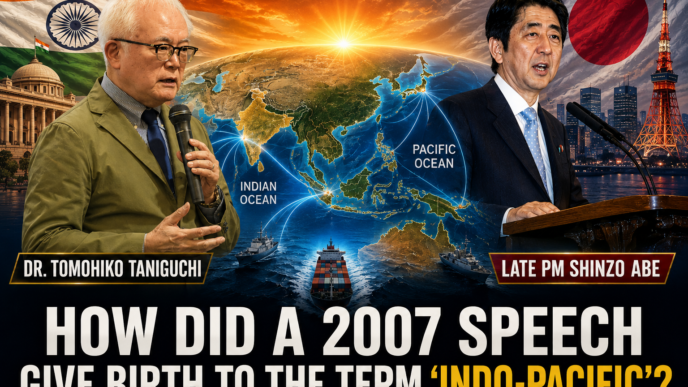
Dr. Tomohiko Taniguchi, Special Advisor and Speechwriter to the late Prime Minister Shinzo Abe, opened his remarks with a tribute to CIJ’s founder, Nupur Tewari — describing her as a self-made entrepreneur who arrived in Japan with limited prior knowledge of the country, settled in Matsuyama, Ehime, and built from there the network that made the day’s extraordinary gathering possible.
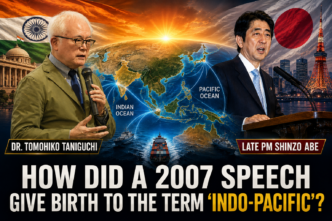
He then turned to a story that reframed the entire day’s gathering in its proper historical scale. It was the summer of 2007 — nineteen years ago, he said — when Prime Minister Abe, despite being in poor health, traveled to India and was granted the rare honor of addressing a joint session of the Indian Parliament in New Delhi. The friendship he had built with then-Prime Minister Manmohan Singh had made it possible. Dr. Taniguchi had spent many sleepless nights drafting that speech. The title came to him when he stumbled on a Mughal prince’s book — Dara Shikoh’s “Majma ul-Bahrayn,” meaning Confluence of the Two Seas. He chose it as the title of Abe’s address.

The speech opened with a line from Swami Vivekananda — that different rivers, flowing from different streams, all eventually mingle together in the sea. The moment Abe said it, Dr. Taniguchi recalled, the members of Parliament in the Central Hall dropped their jaws: here was a Japanese leader who knew Indian thought more intimately than they had imagined. That address, he said, is now widely credited as the genesis of the term “Indo-Pacific” — which has since supplanted the older “Asia-Pacific” framing that had defined the region since the institutional architecture of the 1980s.
When History Speaks: A Message of Peace and Shared Heritage
H.E. Mr. Umio Otsuka — Chief Priest of Yasukuni Jinja, former Ambassador Extraordinary and Plenipotentiary of Japan, and Vice Admiral (Ret.) of the Japan Maritime Self-Defence Force — offered one of the day’s most reflective addresses, weaving together history, spirituality, and a shared commitment to peace.
He drew striking philosophical parallels between Shinto and Hindu traditions — both polytheistic, both rooted in reverence for nature and ancestors, both without a specific founder, both deeply tolerant of other faiths. Japanese and Indian peoples, he said, share a foundational affinity that allows for effortless mutual understanding.

He then turned to a pivotal moment in the history of the two nations: the 1943 wartime voyage of Netaji Subhas Chandra Bose, the Indian independence leader, who on April 26 transferred from a German U-boat to Imperial Japanese Navy submarine I-29 in the Indian Ocean — en route to continuing his campaign for India’s freedom. The spirits of the crew who carried him, Otsuka noted quietly, are enshrined at Yasukuni Jinja. The independence Netaji sought, and the peace that Japan’s predecessors built through sacrifice, are both the result of a single unyielding will: to hand a peaceful country down to the next generation.
A Panel on Mobility, Finance, and the Future

In a panel discussion bringing together three of the most senior Indian executives in corporate Japan, Mr. Rakesh Kochhar, Senior Vice President & Global Head of Auto Finance & Insurance at Nissan Motor Corporation, Mr. Ajay Singh, Senior Executive Advisor at Mitsui O.S.K. Lines (MOL), and Mr. Dhruv Anand, Country Head & Managing Director of Wipro Japan, discussed mobility and auto finance, maritime trade and logistics, and the future of India’s technology footprint in Japan — three different industries united by the same conviction in the depth of the India-Japan partnership.
A Living Bridge: Dr. Lekh Raj Juneja

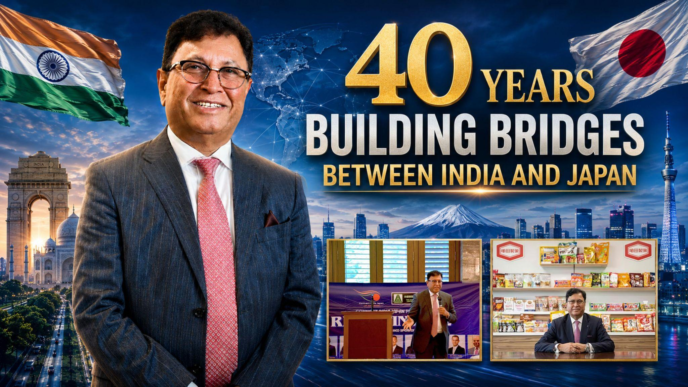
Dr. Lekh Raj Juneja, Chairman & CEO of Kameda Seika Co., Ltd. — Japan’s number-one rice cracker and snack company — took the stage as a remarkable embodiment of the India-Japan story in his own right. A recipient of the Pravasi Bharatiya Samman Award, India’s highest honor for its diaspora, presented by President Droupadi Murmu, Dr. Juneja has spent four decades building bridges between the two nations through enterprise, science, and commerce. His address traced that personal journey from Osaka University to leading one of Japan’s most iconic food companies — weaving together the hard lessons of doing business across two very different markets with a broader reflection on what makes the India-Japan partnership distinct: patience, mutual respect, and a long-term view rarely found in global business today.
A Day of Connection
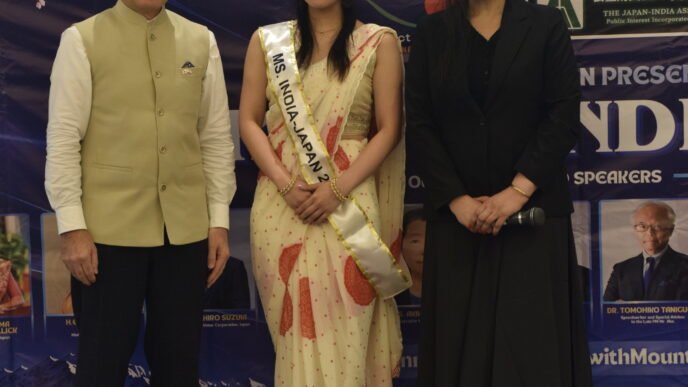
Beyond the keynotes and panels, Rising India 2 was designed to forge real partnerships rather than mere conversation. The conclave also played host to the crowning of a new Ms. India Japan, the cultural ambassador title CIJ first introduced at a dedicated event last September. The day closed, as it began, with a dance performance — bringing a historic gathering full circle.


About Connect India Japan
Connect India Japan (CIJ) is a platform dedicated to strengthening bilateral relations between India and Japan through flagship events, content, and community-building across business, culture, and policy. Founded by Nupur Tewari, who has called Japan home for more than two decades, CIJ also publishes CIJ Today, a Japan-India focused news platform and magazine. Rising India 2 is CIJ’s flagship India-Japan business conclave.