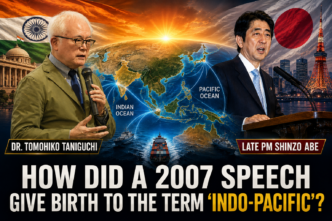
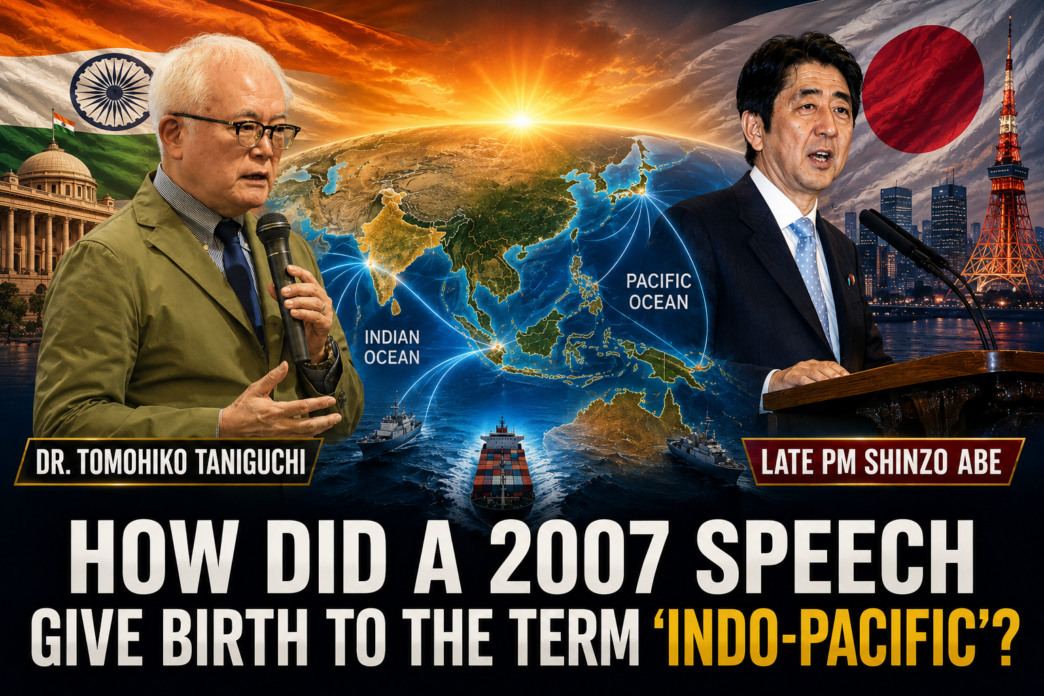
Tokyo, Japan: Speaking at the Rising India 2 India-Japan Business Conclave, Dr. Tomohiko Taniguchi, speechwriter and former Special Advisor to the late Japanese Prime Minister Shinzo Abe, recounted how Abe’s 2007 “Confluence of the Two Seas” address to the Indian Parliament gave rise to the term “Indo-Pacific,” now central to regional geopolitics.
Before turning to Abe, Dr. Taniguchi briefly acknowledged Nupur Tewari, founder of Connect India Japan and organiser of the conclave, crediting her network-building efforts in Japan for making the gathering possible and asking the audience to recognise her work.
 WhatsApp Image 2024 07 01 at 13.58.28 4cfca4e0
Standing In for Abe
Dr. Taniguchi said he was, in a sense, standing in for Shinzo Abe, Japan’s longest-serving prime minister, who was assassinated in July 2022 while campaigning in Nara. He said it was important, at this time of year, to once again remember who Abe was and what he did for Indo-Japanese relations.
He recalled that in the summer of 2007 — nineteen years ago in August — Abe’s physical condition was at its worst, yet he made a journey to India. Because of his already friendly relationship with Manmohan Singh, then Prime Minister of India, Abe was given the opportunity to address members of the Indian Parliament in Delhi. Dr. Taniguchi said he had the privilege of working with Abe on drafting that speech, and that it was extremely well received — so well received that Abe remembered it for the rest of his life.
The Speech That Laid the Foundation for the Indo-Pacific Concept
Dr. Taniguchi recalled that Abe opened the speech by quoting Swami Vivekananda — “different streams from different rivers all mingle together in the sea” — words originally delivered to the Chicago World Parliament of Religions. When Abe said this in the Central Hall of the Indian Parliament, Dr. Taniguchi said, people were astonished that a Japanese leader understood India so deeply. He said that was exactly the intention: to project the image of a Japanese leader willing to take Indo-Japanese relations higher.
He said that while writing the speech, he spent many sleepless nights, during which he came across a book by Dara Shikoh, one of the Mughal princes, titled Confluence of the Two Seas — a title he found perfectly appropriate and chose for Abe’s August 2007 speech. He said that speech is widely regarded as the genesis of the Indo-Pacific concept.
Dr. Taniguchi explained that before this speech, the term used was “Asia-Pacific” — a concept Australia and Japan had promoted in the 1980s, leading to institutions such as APEC. But by 2007, he said, China had already overtaken Japan economically, and India had begun its growth trajectory, so the Asia-Pacific framework no longer captured regional dynamics or India’s rise. He said this is why a broader concept was introduced: two oceans coming together into one shared seascape.
He said the term “seascape” was chosen deliberately. Viewed from the region, he explained, China represents a land-based power, while Japan is an island and trading nation, and beyond China lies another maritime democracy — India. He said that to expand Japan’s strategic horizon, India has been, and would continue to be, one of its most important partners.
A Long-Term Vision Takes Shape
Dr. Taniguchi said that back in 2007, not many people in Japan saw India’s potential the way he did. He recalled discussing this with colleagues at the Foreign Ministry, where he said there was little long-term vision at the time, and where many officials viewed working with India as a demanding and complex relationship. He said he saw this as a golden opportunity: if there was no creative direction from others, he could help fill that gap. He added that the speech was a rare accomplishment, in that he did not have to rewrite it repeatedly, unlike most prime ministerial speeches.
He also said that while preparing the speech, he reflected on long-standing civilizational links between Japan and India, especially through Bengal — noting that Swami Vivekananda and Rabindranath Tagore were both from Bengal, and that the Japanese intellectual Okakura Tenshin had deep connections with Bengali thinkers, giving Japan-India relations rich intellectual soil to grow from.
Abe’s Long View on India
Dr. Taniguchi said that, looking back, it should not be him standing there that day — it should have been Abe himself, speaking about his own long-term vision. He said that by speaking of the “Confluence of the Two Seas” and drawing on India’s classical intellectual traditions, Abe was investing in the future of India, which Abe believed represented the future itself. Dr. Taniguchi said Abe believed that in 20 to 30 years, India’s economy could overtake China’s, and that India would remain, at its core, a democracy. He said that for Japan, it is far more meaningful to work closely with India than with an uncertain regional giant whose direction is unpredictable.
Rising India 2 was organised by Connect India Japan, a platform founded by Ms. Tewari that has organised a series of India-Japan conclaves in both Tokyo and New Delhi, aimed at strengthening bilateral relations between the two countries.