
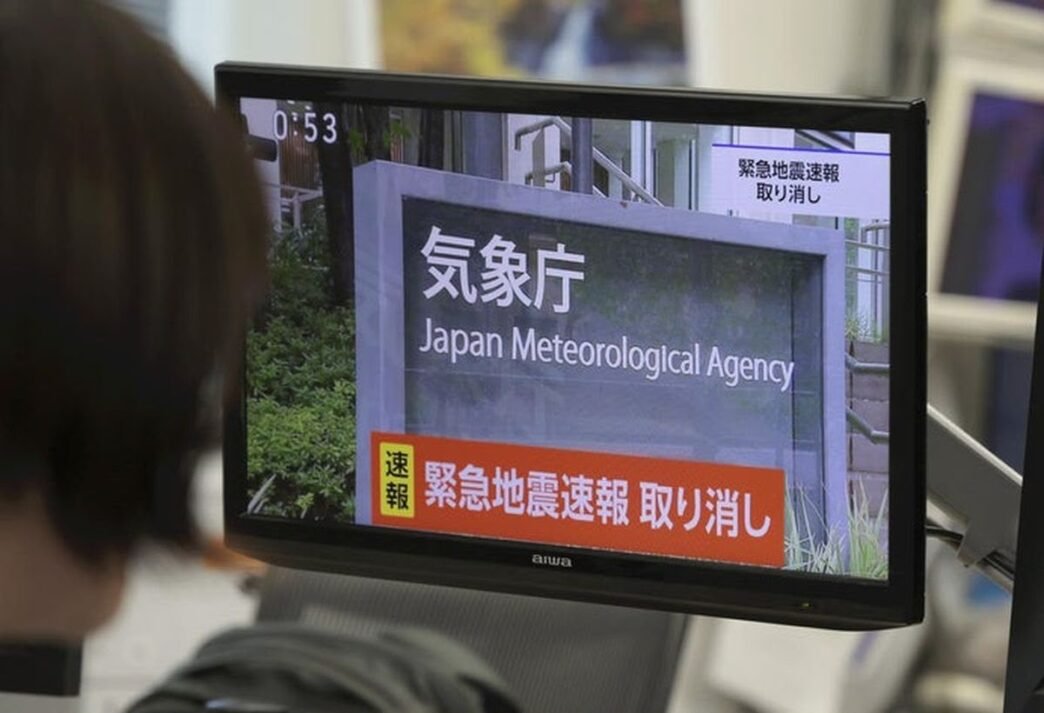
Japan’s Meteorological Agency (JMA) canceled an earthquake early warning on October 16, 2026, just eight minutes after issuing an alert that prompted concern across wide areas of the country. The warning followed a magnitude 6.9 earthquake near the Kamchatka Peninsula in Russia’s Far East.
The alert had warned residents across northern, eastern and central Japan to prepare for strong shaking. However, the expected strong tremors were not observed, and the agency subsequently withdrew the warning.
 WhatsApp Image 2024 07 01 at 13.58.28 4cfca4e0
Earthquake Alert Issued Across Wide Areas
The JMA issued the earthquake early warning at around 12:40 p.m. local time after detecting seismic activity near the Kamchatka Peninsula.
The alert covered a broad area stretching from Hokkaido in northern Japan toward the Tohoku, Kanto and Tokai regions. Emergency notifications were sent to mobile phones and public alert systems, prompting people to prepare for possible strong shaking.
Magnitude 6.9 Earthquake Triggered the Alert
A magnitude 6.9 earthquake occurred near the Kamchatka Peninsula at approximately 12:38 p.m., according to reports. The JMA’s warning system appears to have incorrectly interpreted the seismic data, resulting in an alert that overestimated the expected shaking across Japan.
The agency canceled the warning at around 12:48 p.m. The maximum seismic intensity actually observed in Japan was reported as 1 on the country’s seven-level seismic intensity scale.
No tsunami warning or advisory was issued following the earthquake, according to The Japan Times. The quake was reportedly felt lightly in Hakodate, Hokkaido, while no significant shaking was observed in Tokyo’s Minato Ward.
The cancellation clarified that the widespread strong shaking anticipated in the initial alert had not materialised.
How Japan’s Earthquake Early Warning System Works
Japan’s earthquake early warning system is designed to detect seismic waves and notify the public before stronger shaking reaches affected areas, when time allows. The warning can give people seconds to take protective action, such as moving away from windows, taking cover and securing themselves.
However, the JMA notes that the system has limitations. Rapid magnitude estimates, incomplete early seismic data and difficulties distinguishing simultaneous or nearby earthquakes can affect warning accuracy. False alerts are possible, and people near an earthquake’s source may experience shaking before a warning arrives.
JMA Investigates the Warning Error
The agency is investigating why the system generated the erroneous alert. The incident highlights the challenge of providing rapid earthquake warnings while interpreting seismic information in real time.
Despite the cancellation, residents are advised to continue following official disaster information and take appropriate precautions whenever an earthquake warning is issued.
The cancellation of Japan’s earthquake early warning on October 16 highlights both the importance and the limitations of rapid seismic alert systems. Although the anticipated strong shaking did not occur, the incident underscores the need for accurate monitoring, continued system improvements and public awareness of earthquake safety procedures.