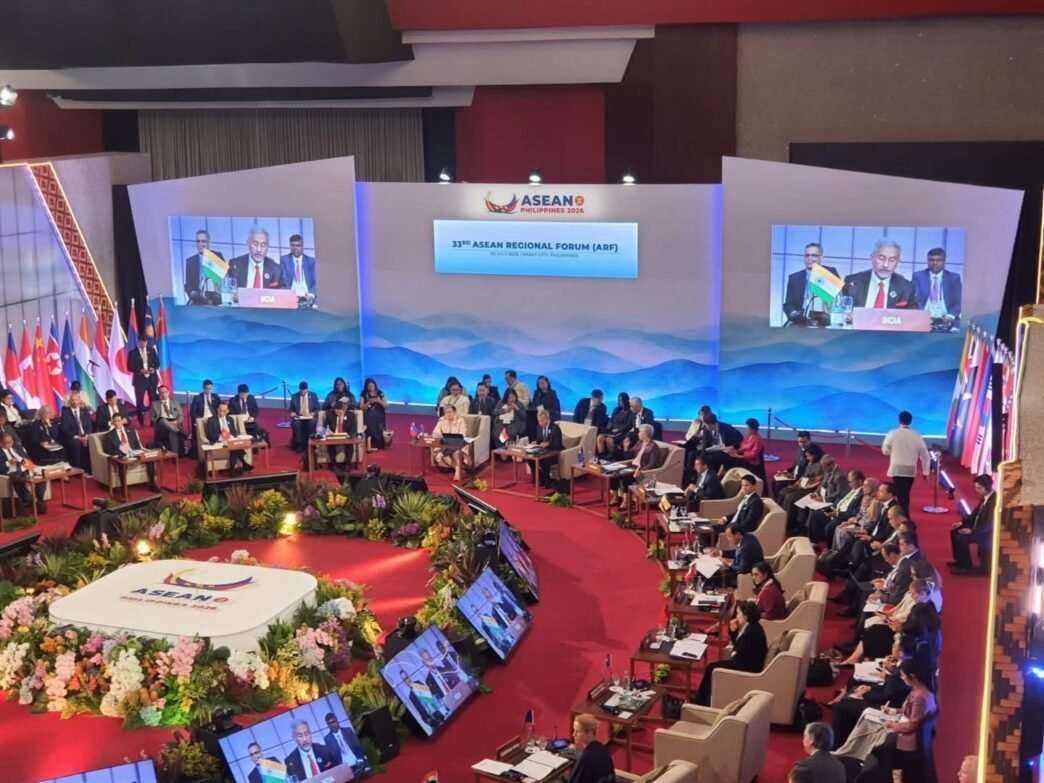
External Affairs Minister Dr. S. Jaishankar outlined India’s vision for a secure, resilient, and rules-based Indo-Pacific at the 33rd ASEAN Regional Forum (ARF) Ministerial Meeting in Manila, Philippines. Addressing ministers and delegates from across the region, Jaishankar described the ARF as an important platform for dialogue on political and security issues amid an increasingly complex global landscape.
Welcoming the Manila Action Plan, he noted that its five pillars align closely with India’s Indo-Pacific approach, which emphasizes peace, stability, inclusive development, and respect for international law. He also reaffirmed India’s commitment to strengthening regional cooperation through practical initiatives in disaster management, maritime security, emerging technologies, and counterterrorism.
 WhatsApp Image 2024 07 01 at 13.58.28 4cfca4e0
India’s Priorities at the ASEAN Regional Forum
Jaishankar highlighted several key areas where India is actively contributing to regional and global security.
Key highlights included:
● Support for the Manila Action Plan and a free, open, and inclusive Indo-Pacific
● Promotion of disaster relief cooperation through training, common operating procedures, and tabletop exercises
● Continued support for the Coalition for Disaster Resilient Infrastructure (CDRI)
● India’s humanitarian assistance in countries affected by cyclones and earthquakes
● Strong call for zero tolerance towards terrorism and cutting off terror financing
● Progress in maritime security through information sharing and Indian Navy deployments
● Advocacy for a human-centric approach to artificial intelligence and stronger cooperation against cybercrime
● Emphasis on safe and uninterrupted maritime trade
● Support for an effective and UNCLOS-compliant Code of Conduct for the South China Sea
India also underlined the importance of maintaining peace and stability in the Indo-Pacific by strengthening maritime cooperation and ensuring freedom of navigation. Jaishankar reiterated that attacks on commercial shipping and civilian infrastructure are unacceptable and stressed the need for international collaboration to address shared security challenges.
On the South China Sea, India called for the early conclusion of a legally effective Code of Conduct (CoC) that is fully consistent with the 1982 United Nations Convention on the Law of the Sea (UNCLOS) and respects the legitimate rights of all parties.
1. Strengthening the Indo-Pacific
India reaffirmed its commitment to a free, open, and rules-based Indo-Pacific region.
2. Enhancing Disaster Resilience
The country continues to support regional preparedness through humanitarian assistance and disaster-response initiatives.
3. Combating Terrorism
India called for stronger international action against terrorism and its financial networks.
4. Addressing Emerging Challenges
The discussions highlighted cooperation on artificial intelligence, cybercrime, maritime security, and regional stability.
At the 33rd ASEAN Regional Forum Ministerial Meeting, S. Jaishankar reaffirmed India’s commitment to strengthening regional cooperation through diplomacy, disaster resilience, maritime security, counterterrorism, and responsible technology governance. His address reflected India’s continued focus on working with ASEAN partners to promote peace, security, and sustainable development across the Indo-Pacific region.