
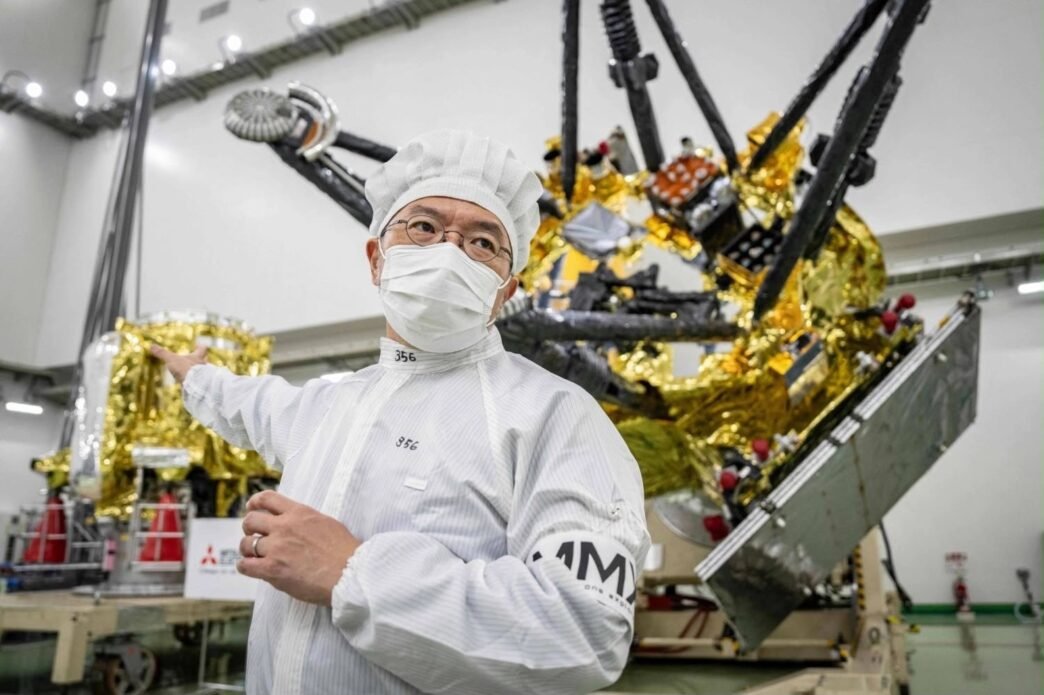
Japan is preparing for one of its most ambitious deep-space missions yet: a journey to Mars and its two small moons, Phobos and Deimos. Led by the Japan Aerospace Exploration Agency (JAXA), the Martian Moons eXploration (MMX) mission aims to study the mysterious moons and bring samples of Phobos back to Earth.
The mission is planned for launch in Japan’s fiscal year 2026aboard an H3 rocket from the Tanegashima Space Center. If successful, MMX would achieve the world’s first sample return from the Mars region.
 WhatsApp Image 2024 07 01 at 13.58.28 4cfca4e0
Japan’s Mission to the Moons of Mars
MMX will travel approximately one year to reach the Martian system. Once there, the spacecraft will observe both Phobos and Deimos while focusing its sample-collection efforts on Phobos.
Key objectives include:
● Exploring Phobos and Deimos
● Collecting more than 10 grams of material from Phobos
● Studying the moons’ composition and structure
● Investigating how the moons were formed
● Learning more about the evolution of Mars
● Developing technologies for future deep-space missions
The origins of Mars’ two moons remain an important scientific mystery.
Scientists are studying two major possibilities: the moons could be asteroids captured by Mars’ gravity, or they could have formed from material thrown into orbit after a massive impact on early Mars.
By analysing material collected directly from Phobos, researchers hope to gain new evidence that could help determine which explanation is correct.
The MMX mission is designed as a long-term expedition.
The planned timeline includes:
● 2026: Launch aboard Japan’s H3 rocket
● 2027: Arrival in the Martian region
● 2027–2030: Observation of Phobos and Deimos and sample collection
● 2030: Departure from the Martian system
● 2031: Planned return of samples to Earth
MMX will also deploy the IDEFIX rover, developed with contributions from the German Aerospace Center and France’s CNES.
The rover is designed to operate in Phobos’ extremely low-gravity environment and help researchers understand the surface before and during the spacecraft’s exploration.
Although MMX is led by Japan, the mission is an international effort involving organisations including NASA, CNES, DLR and ESA.
This cooperation brings together scientific instruments, engineering expertise, and research teams from several countries.
1. Understanding Mars’ History
Studying Phobos and Deimos could provide clues about how the Martian system evolved.
2. Investigating the Origins of the Moons
Returned samples could help scientists determine whether the moons are captured asteroids or remnants of material produced by an ancient impact.
The mission will test technologies needed for travelling between Earth and Mars, landing on small celestial bodies, collecting samples, and communicating across deep space.
4. Preparing for Future Exploration
The technologies and knowledge developed through MMX could contribute to future robotic and human exploration of Mars and its surroundings.
Japan’s MMX mission represents a major step in the country’s deep-space exploration programme. By travelling to Phobos and Deimos and bringing material from Phobos back to Earth, JAXA hopes to answer long-standing questions about the origins of Mars’ moons while developing technologies that could shape the future of planetary exploration.