
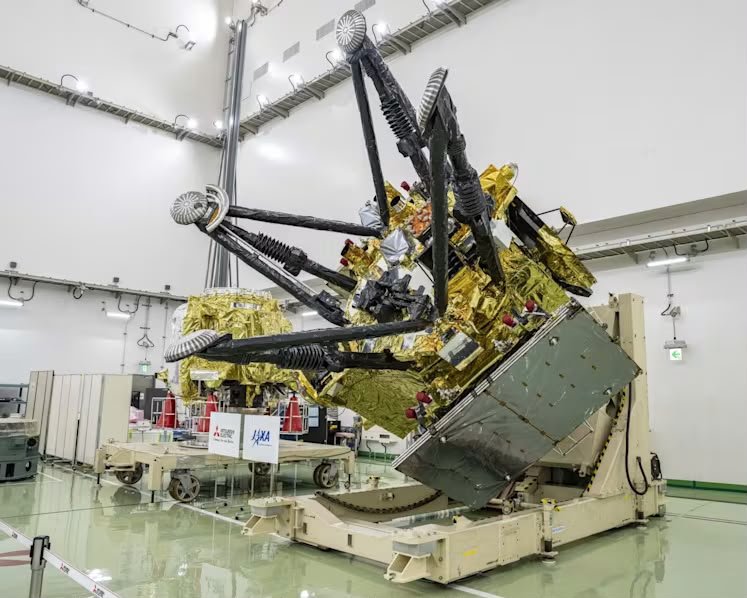
Japan is preparing for an ambitious journey to Mars and its two moons, Phobos and Deimos. The unmanned Martian Moons eXploration (MMX) mission, led by the Japan Aerospace Exploration Agency (JAXA), is scheduled for launch from the Tanegashima Space Center in fiscal 2026.
The mission aims to collect material from Phobos and return it to Earth, potentially giving scientists new information about how Mars, its moons and the early Solar System developed.
 WhatsApp Image 2024 07 01 at 13.58.28 4cfca4e0
What Is Japan’s MMX Mission?
MMX is designed as a sample-return mission focused primarily on Phobos, the larger of Mars’ two moons.
Key objectives include:
● Studying Phobos and Deimos
● Collecting at least 10 grams of material from Phobos
● Returning samples to Earth
● Investigating the origins of Mars’ moons
● Studying the evolution of the Martian system
● Exploring processes involved in the formation of the Solar System
Why Are Mars’ Moons Important?
Scientists are still uncertain about how Phobos and Deimos formed.
One possibility is that they are asteroids captured by Mars’ gravity. Another theory suggests they may have formed from debris produced by a massive impact on Mars.
Analysing material directly collected from Phobos could help researchers determine which explanation is more likely.
A Journey to Phobos
After launch, MMX is expected to reach the Martian system roughly a year later. The spacecraft will study both moons, while its sample-collection activities will focus on Phobos.
The mission is expected to spend around three years operating in the Martian system before returning the samples toward Earth, with the return planned for around 2031.
Rover Will Explore Phobos
MMX will carry the IDEFIX rover, developed through cooperation involving Germany’s DLR and France’s CNES.
The rover will explore Phobos’ surface and provide information that can help researchers understand the moon’s unusual environment and extremely weak gravity.
Clues to the Early Solar System
The importance of MMX extends beyond Mars.
Scientists hope that studying Phobos could provide information about the materials present during the early formation of the Solar System. JAXA says the mission could help investigate how materials such as water and organic matter were transported through the early Solar System and how planetary environments developed.
Could MMX Help Future Human Missions?
The mission also has technological significance. Operating around Mars and landing on a small, low-gravity body will allow engineers to test technologies and gather experience relevant to future deep-space exploration.
The mission could therefore contribute to Japan’s longer-term ambitions for exploring the Mars system, although it is not a crewed mission.
Why This Matters
1. Understanding Mars’ Moons
MMX could help resolve the long-standing mystery surrounding the origins of Phobos and Deimos.
2. Studying Solar System History
Returned samples could provide scientists with valuable evidence about conditions during the early Solar System.
3. Advancing Space Technology
The mission will test technologies for navigating, landing, collecting samples and operating around small celestial bodies.
4. Preparing for Future Exploration
The knowledge and technologies developed through MMX could support future robotic and potentially crewed exploration of the Mars system.
Final Word
Japan’s MMX mission represents a major step in planetary exploration. By travelling to Phobos and Deimos and bringing samples from Phobos back to Earth, Japan hopes to uncover clues about the origins of Mars’ moons and the early Solar System. The mission could also provide valuable experience for future exploration farther into the solar system.