

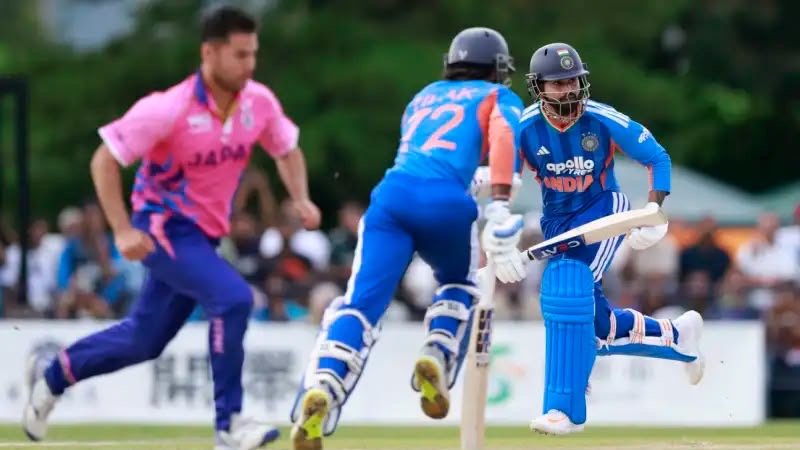
India survived a huge scare from Japan in a thrilling Suzuki Cup T20 International at Sano, winning by just two runs in a match that went down to the final delivery.
The rain-affected contest was reduced to just five overs per side, with India posting 32/4 before Japan fought back to finish on 30/3. The Japan Cricket Association’s official record confirms India’s two-run victory.
 WhatsApp Image 2024 07 01 at 13.58.28 4cfca4e0
The historic fixture was the first men’s T20I meeting between India and Japan and was organised as part of celebrations marking 75 years of India-Japan diplomatic relations.
Rain Reduces Historic Match to Five Overs
Heavy rain and a wet outfield delayed the start at the Sano International Cricket Ground in Tochigi.
After the delay, the match was reduced to a five-over-a-side contest, turning the historic fixture into a fast-paced battle where every delivery mattered.
India captain Shreyas Iyer won the toss and chose to bat, but Japan’s bowlers made life difficult on the slow surface.
India struggled to score freely against Japan’s spin-heavy attack.
Shreyas Iyer top-scored with 16 runs, while India’s other batters found it difficult to accelerate.
India eventually finished their five overs at:
India: 32/4
With only 33 required for victory, Japan suddenly had a realistic opportunity to produce one of the biggest upsets in their cricket history.
Japan Push India to the Final Ball
Japan’s chase began under pressure, but the hosts remained in the contest.
India’s spinners kept the scoring under control, while Japan’s batters continued to chase the small target.
Going into the final over, Japan needed eight runs to win.
That left India with very little room for error.
Axar Patel was handed the responsibility of bowling the final over.
Japan needed eight runs, but Axar conceded only five, keeping the hosts below the target.
Japan finished their five overs at:
Japan: 30/3
India therefore secured a dramatic two-run victory.
The final over also produced a controversial moment involving a wide-ball decision, which became a major talking point after the match.
With Japan needing runs from the final deliveries, the decision added another layer of tension to an already close contest.
Despite the drama, India’s bowlers managed to defend the extremely small total.
Japan Can Take Plenty From the Performance
For Japan, the result was a narrow defeat but a significant performance against a leading international side.
Japan took the match to the final ball despite facing India in their first-ever men’s T20I meeting.
Japan captain Kendel Kadowaki-Fleming said afterward that he was proud of how close his team came against India.
The performance also comes at an important moment for Japanese cricket, with the country preparing for the 2026 Asian Games.
India’s Asian Games Preparation
The Suzuki Cup was also part of India’s preparation for the men’s cricket competition at the Asian Games.
The match gave India’s players valuable exposure to unfamiliar conditions in Japan ahead of their Asian Games campaign. The BCCI had described the fixture as part of the “Sport 75” initiative connected with the 75th anniversary celebrations of India-Japan diplomatic relations.
India and Japan’s men’s teams played their first-ever T20I against each other.
Despite India’s status as a leading cricket nation, Japan pushed the match right to the final delivery.
All 10 overs were bowled by spinners, reflecting the difficult batting conditions at Sano.
4. Cricket Gets a Major Spotlight in Japan
The match brought India’s national team to Japan for the first time and formed part of the celebrations around India-Japan relations.
What was expected to be a historic cricket match became a five-over thriller in Sano.
India’s 32/4 looked modest, but their bowlers managed to defend it as Japan finished just two runs short at 30/3.
For India, it was a narrow victory. For Japan, it was a performance that showed how competitive the country’s cricket team could be on a major international stage.
India survived. Japan pushed them to the limit. And Sano witnessed a truly unforgettable cricketing contest. 🇮🇳🇯🇵🏏