
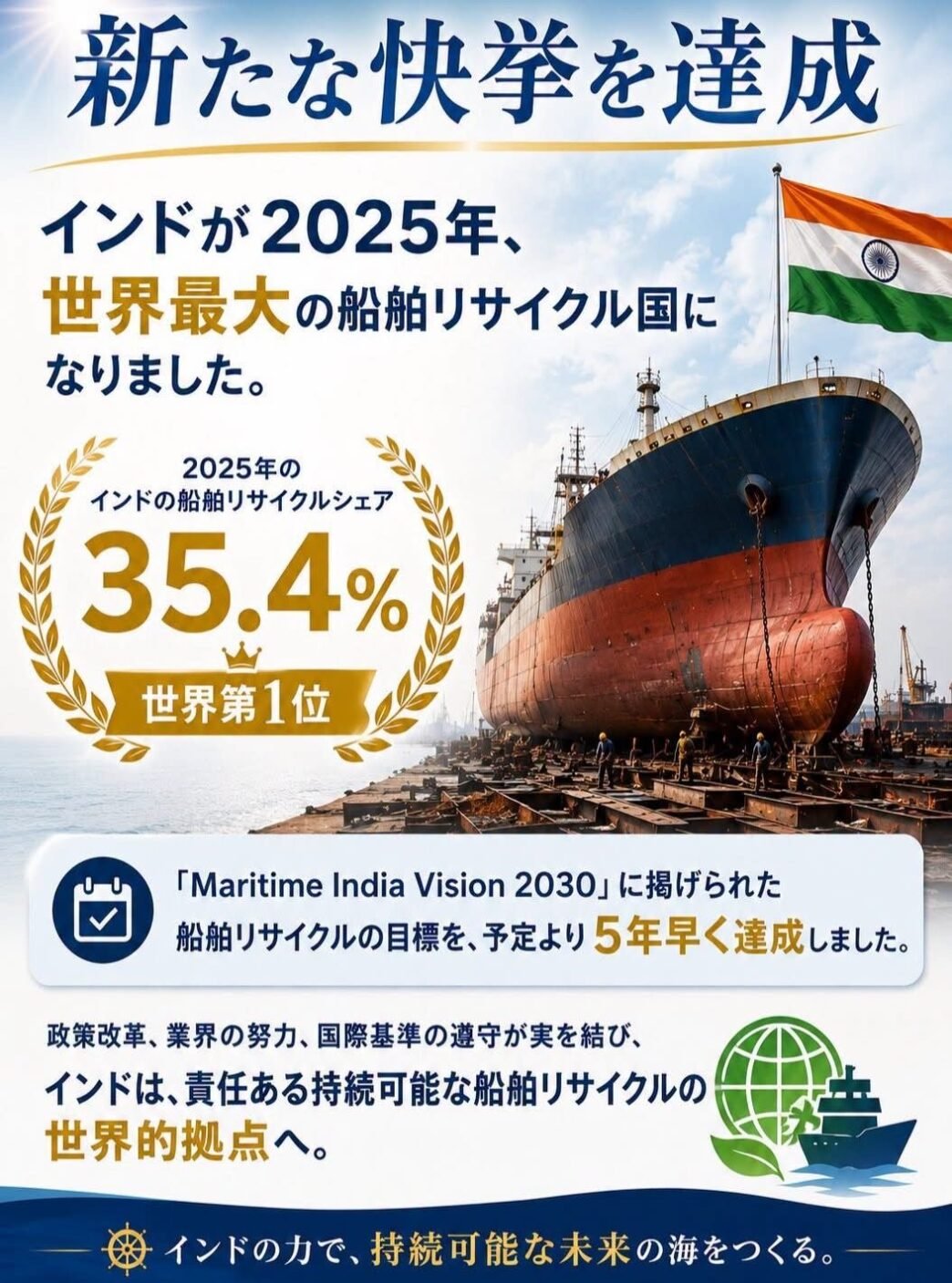
India has achieved another significant milestone in its maritime journey, emerging as the world’s largest ship recycling nation in 2025. According to data from the United Nations Conference on Trade and Development (UNCTAD), India now accounts for 35.4% of global ship recycling activity, placing it at the top of the international rankings.
The achievement marks a major success for India’s maritime sector and comes five years ahead of the target outlined in the government’s ambitious Maritime India Vision 2030.
 WhatsApp Image 2024 07 01 at 13.58.28 4cfca4e0
India Reaches Global Leadership Position
The country’s rise to the number one position reflects years of strategic reforms, infrastructure development, and industry modernization aimed at strengthening the ship recycling sector.
Key factors behind the achievement include:
● Progressive policy reforms
● Modernized recycling facilities
● Strong industry participation
● Improved worker safety measures
● Environmental compliance
● Sustainable recycling practices
● International regulatory alignment
The accomplishment demonstrates India’s growing influence within the global maritime economy.
Achieving the Maritime India Vision Early
India’s leadership in ship recycling represents a major milestone under Maritime India Vision 2030, a roadmap designed to transform the nation into a leading maritime powerhouse.
Reaching this target five years ahead of schedule highlights:
● Effective implementation of reforms
● Strong public-private collaboration
● Growing global confidence in Indian facilities
● Enhanced competitiveness
● Improved operational standards
● Long-term sectoral planning
● Sustainable industrial growth
The early achievement underscores the rapid progress made by India’s maritime ecosystem.
Commitment to Sustainability and Safety
India’s ship recycling industry has increasingly focused on responsible and environmentally conscious practices.
The sector has strengthened its reputation through:
● Compliance with international environmental standards
● Improved occupational safety measures
● Responsible waste management
● Green recycling initiatives
● Sustainable resource recovery
● Modernized infrastructure
● Enhanced regulatory oversight
These efforts have helped position India as a trusted global hub for sustainable ship recycling.
Economic and Environmental Benefits
The growth of ship recycling contributes significantly to both economic development and environmental sustainability.
Benefits include:
● Employment generation
● Resource conservation
● Steel recovery and reuse
● Industrial growth
● Reduced environmental impact
● Foreign investment opportunities
● Strengthened maritime capabilities
The industry plays a crucial role in supporting India’s circular economy objectives.
India now leads the world in ship recycling with the highest global market share.
2. Early Achievement of National Goals
The Maritime India Vision 2030 target has been accomplished five years ahead of schedule.
3. Sustainable Industrial Development
The industry demonstrates how economic growth and environmental responsibility can progress together.
4. Strengthening India’s Maritime Leadership
The achievement reinforces India’s position as a key player in the global maritime sector.
India’s emergence as the world’s largest ship recycling nation is a landmark achievement that reflects years of policy innovation, industry commitment, and sustainable development. By securing a 35.4% global share and achieving its Maritime India Vision 2030 target well ahead of schedule, India has further strengthened its standing as a global maritime leader and a model for responsible ship recycling worldwide.