

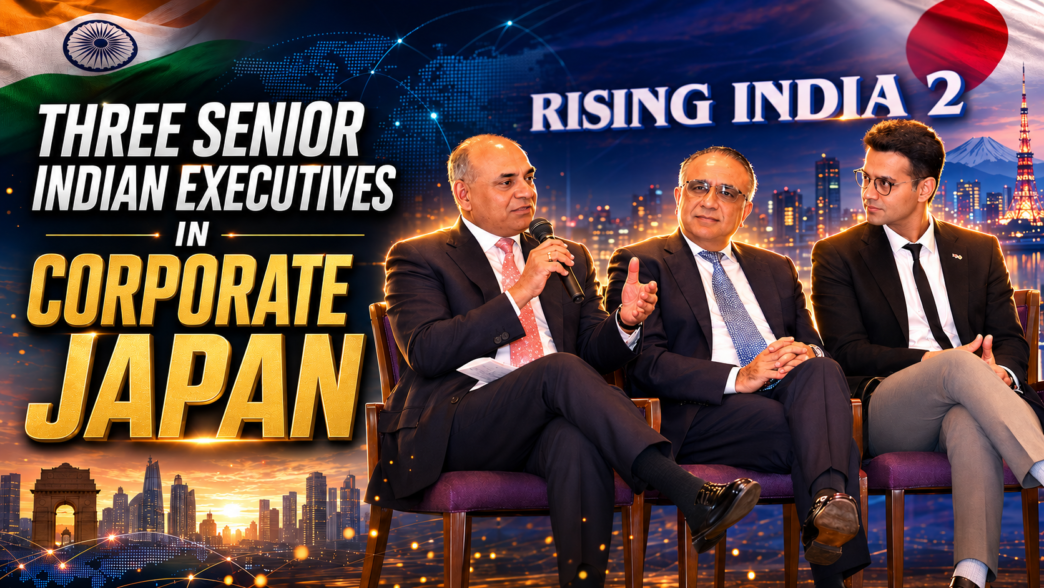
Tokyo, Japan: At the Rising India 2 India-Japan Business Conclave held at the Akasaka Prince Classic House in Tokyo, a panel discussion brought together three of the most senior Indian executives in corporate Japan for one of the most candid and wide-ranging conversations of the day — covering startups, R&D, sustainability, civic sense, and what India must genuinely learn from Japan.
The panelists were Mr. Dhruv Anand, Country Head & Managing Director of Wipro Japan; Mr. Rakesh Kochhar, Senior Vice President & Global Head of Auto Finance & Insurance Business at Nissan Motor Corporation; and Mr. Ajay Singh, Senior Executive Advisor at Mitsui O.S.K. Lines (MOL). The discussion was moderated by Ms. Nupur Tewari, Founder of Connect India Japan.
 WhatsApp Image 2024 07 01 at 13.58.28 4cfca4e0
“There Has Never Been a Better Time for This Collaboration”
Asked how India and Japan could combine their respective strengths in the startup ecosystem, Mr. Anand opened by paying tribute to the gathering itself, taking ten seconds, he said, to applaud Ms. Nupur Tewari for organizing the event. He then spoke of Wipro’s own seventy-five-year journey — from selling sunflower oil, to manufacturing PCs in the 1970s, to becoming a global IT company post-2000 — as an example of what he called a “startup mindset”: the willingness to challenge oneself and cannibalize one’s own business.
“Technology depth in Japan is extensive. Domain depth in Japan is extensive,” he said. “India comes with two very important things: one is an experimental attitude — we experiment a lot, even when we know the answers. And two, the talent and scale that India has.” He argued that when Japan’s domain-specific, industry-specific technologies — from companies like Suzuki, Honda, Toyota, and Daikin — combine with the agility of the Indian startup ecosystem, “what you have left is exactly what the world needs right now.” He added that Wipro Ventures, Wipro’s startup investment arm, is already on this path, and invited startup members in the audience to reach out directly.
Mr. Kochhar built on this, noting that Nissan — along with Renault — has invested more than a billion dollars in India and is exporting one hundred thousand cars from the country. He pointed to growing Japanese interest in Indian fintech and banking, with several Japanese banks already taking stakes in Indian financial companies. “What India offers is Indian entrepreneurs. We offer massive market. We offer growth. We offer agility. We offer speed of decision-making,” he said. “What Japan offers is very high quality, very high work ethics, very high precision manufacturing.” He said the future of India-Japan collaboration lies beyond manufacturing — in AI and new technologies where the combined strengths of both nations can produce something meaningful for the world.
Mr. Singh took a more structural view. He noted that startups, to him, are synonymous with nurturing — a space where young people take risks, innovate, and need both capital and stewardship to grow. He cited NASA’s experience of opening up a complex mathematical problem to the world and finding a solution from a young person in Hungary as an example of what democratizing innovation can achieve. He also shared a recent example from MOL itself: the company invested in a startup in Darjeeling working on enhanced rock weathering — crushing rock and mixing it with soil to absorb carbon dioxide from the atmosphere while benefiting farmers. “The power of startups is actually about democratizing and reaching out and connecting people all over,” he said.
The R&D Gap — and Why It Matters
Mr. Singh raised one of the sharpest points of the discussion, noting that Indian companies spend less than one percent of sales on R&D, compared to four to six percent for Japanese corporations. “A lot of Indian companies now stagnate, and they look for the typical old business model — come to Japan, find a partner, get technology,” he said. “Those are low-hanging things, frankly. But you need to innovate.” He urged Japanese corporations to set up R&D centers in India, pointing to Shell as an example — a company that established one of only three global R&D centers in Bangalore approximately twenty years ago, which today employs more than two thousand scientists and engineers and handles most of Shell’s engineering for its offshore platforms. “This is an aspect of India which is not fully appreciated in Japan yet,” he said.
Mr. Kochhar added that Nissan’s Renault-Nissan Technology Center in Chennai employs approximately seven thousand engineers doing R&D and digital work. “India has vast engineering talent, and big companies are going there,” he said, urging more Japanese companies to follow.
On Sustainability: From Gandhi to Hokkaido
When the conversation turned to sustainability, Mr. Singh opened with a quote from Mahatma Gandhi: “The Earth is big enough for everyone’s need, but not big enough for everyone’s greed.” He spoke candidly about the gap between what corporations say about sustainability and what they actually practice — pointing to private jets flying into climate conferences as an example of the contradiction. He argued that sustainability starts in the mind, and that both India and Japan share a cultural instinct for making the most of what is available. He praised Japan’s aging but functional IT infrastructure as an example of getting the most out of existing assets rather than embracing a disposable economy. He also stressed that carbon is only one part of the sustainability problem, and that in India, one of the biggest issues is garbage and the maintenance of public spaces.
Mr. Kochhar spoke of how sustainability is deeply ingrained in Japanese corporate culture — not just in carbon emissions and EV development, but in gender equality targets, water usage reduction, and contributions to local communities. “In India, when you look at the corporate world, it’s more in form than content,” he said, acknowledging that India is still a developing country grappling with basic infrastructure needs, but expressing confidence that it would get there.
Mr. Anand shared a remarkable example of Japanese innovation being applied in India. He described visiting Hokkaido with Wipro’s executive chairman and seeing data centers housed in shipping containers — which generate heat as a byproduct, and use water to cool the containers, producing hot water in the process. Back in India, Wipro replicated this model by placing data centers outside villages near Bangalore, providing hot water to communities that lack electricity to heat it themselves. “This is a learning that came from a far off place in Hokkaido, and its practical use is happening in Bangalore,” he said. “That’s where I think our countries are living together.”
On Civic Sense: What India Must Learn from Japan
An audience member — Rahul, a young chartered accountant who had traveled to Japan specifically for the conclave — asked the panel about civic sense, noting that in India, civics accounts for only five marks out of a hundred in social studies. The response was unanimous and direct.
Mr. Singh said the Japanese practice of teaching children to clean their own schools is a powerful and practical way to instill social responsibility — and that some organizations and governments in India are beginning to recognize this. More fundamentally, he said, Japan has “a high degree of obligation towards society and social consciousness” that is culturally embedded.
Mr. Kochhar was candid. “In India, all of us blame the government. No, it’s us. We are throwing the garbage on the street. We are making it dirty,” he said. He compared his experience working in the United States, Japan, and India, and said Japan’s culture of personal responsibility — where people find a way to dispose of their rubbish properly even if it means carrying it home — is unmatched. “It has to start from parents teaching their kids. It has to start from the schools. Government would not do anything.”
Mr. Anand offered a more balanced reflection, noting that India — a country of 1.4 billion people where sixty-seven percent do not share a common language — faces challenges that Japan simply does not. “We’ve come way far off from where we used to be,” he said. “I am sure we’ll be as good as Japan, if not better.” He shared a personal example of a Japanese initiative where the fire brigade sets up tents in parks on weekends, runs games for children around sorting garbage correctly, and gives out towels as prizes — a simple, practical model he argued is easily replicable in India.
A Message for the Next Generation
Closing the session, each panelist offered a final message for young leaders.
Mr. Anand said the India-Japan partnership has already been won — and urged young entrepreneurs not to think of 2040 or 2070 as the target, but to aim for 2030 and 2035. “Now is the time to pay attention and intention to taking this to where we want it to be,” he said.
Mr. Kochhar’s message was about attitude. “I will hire anybody with a good attitude who may lack a little knowledge, because knowledge can be gained. But I will never hire anybody with great knowledge and a bad attitude. Because the attitude stays with you. Knowledge, you can learn.”
Rising India 2 was organised by Connect India Japan. The conclave was held on June 17, 2026 at the Akasaka Prince Classic House, Tokyo.