
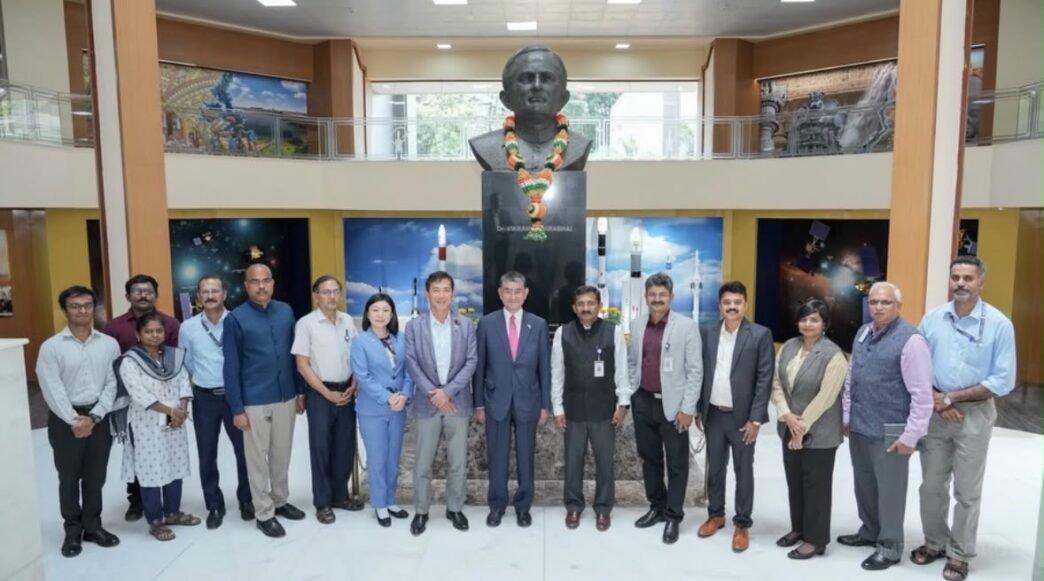
A group of Japanese lawmakers from the Liberal Democratic Party (LDP) is visiting India this week as part of an independent Japan visit programme focused on understanding developments on the ground and strengthening parliamentary exchanges.
The delegation includes Taro Kono, Karen Makishima, Kenji Nakanishi and Sakon Yamamoto. Public profiles confirm that Kono, Makishima, Nakanishi and Yamamoto are Japanese Diet members associated with the LDP.
 WhatsApp Image 2024 07 01 at 13.58.28 4cfca4e0
The programme is designed to give Japanese parliamentarians an opportunity to learn about India’s latest developments, meet local officials and gain first-hand exposure to India’s rapidly expanding technology and innovation ecosystem.
Bengaluru Marks the Start of the Visit
The delegation began its programme in Bengaluru, one of India’s major centres for science, technology, research and innovation.
During the Bengaluru leg, the lawmakers visited:
● Indian Institute of Science (IISc)
● Indian Space Research Organisation (ISRO)
● Bharat Electronics Limited (BEL)
The visits provide an opportunity to examine India’s capabilities across academic research, space technology and defence-related industries.
Focus on Technology and Innovation
Technology is an increasingly important part of India-Japan cooperation.
Karen Makishima’s official LDP profile lists digital policy and space policy among her areas of interest.
The delegation’s Bengaluru programme therefore brings together several areas where the two countries have opportunities for cooperation, including digital technologies, advanced research and space applications.
Taro Kono has also previously visited Bengaluru in his capacity as Japan’s Minister for Digital Transformation, including participation in the G20 Digital Economy Ministers’ Meeting hosted by India in 2023.
IISc, ISRO and Bharat Electronics
The institutions visited by the lawmakers represent different parts of India’s strategic technology ecosystem.
IISc is one of India’s leading research institutions, with work spanning science, engineering and advanced technologies.
The visit to ISRO highlights the growing importance of space cooperation between India and Japan, including opportunities involving research, satellites and space technology.
The visit to Bharat Electronics provides exposure to India’s defence-electronics and strategic technology capabilities.
Together, these engagements offer the delegation a view of India’s ecosystem from research and education to space and industrial technology.
Strengthening the India-Japan Partnership
India and Japan have developed their relationship across economic, technological and strategic areas.
The two countries’ Special Strategic and Global Partnership includes cooperation in areas such as technology, infrastructure, defence, space and economic development.
People-to-people and parliamentary exchanges complement formal government-to-government engagement by giving lawmakers opportunities to directly understand developments in each other’s countries.
The programme allows Japanese parliamentarians to see India’s technological and industrial development directly rather than relying only on briefings.
2. Technology Is a Major Area of Cooperation
Digital technology, artificial intelligence, space and advanced manufacturing are increasingly important areas for India-Japan engagement.
3. Bengaluru Offers a Strong Technology Base
Beginning the visit in Bengaluru places the delegation in one of India’s major centres for research, technology companies and innovation.
4. Parliamentary Exchanges Add Another Layer
Visits by lawmakers can create opportunities for continued dialogue alongside formal diplomatic and government-level cooperation.
The visit comes as India and Japan continue to explore cooperation in AI, technology, space, defence and startups.
For the Japanese lawmakers, meetings with Indian institutions and officials provide an opportunity to better understand India’s changing economic and technological landscape.
For the wider India-Japan relationship, such exchanges can contribute to continued dialogue between policymakers and institutions in both countries.
The Bengaluru leg of the Japanese lawmakers’ India visit highlights how technology, space, defence and innovation are becoming increasingly important parts of India-Japan engagement.
From IISc’s research environment to ISRO’s space capabilities and Bharat Electronics’ defence technology ecosystem, the programme offers the visiting lawmakers a first-hand look at India’s growing strategic and technological capabilities.
The visit reflects the expanding scope of cooperation between India and Japan and the importance of direct exchanges in understanding each other’s strengths and opportunities.